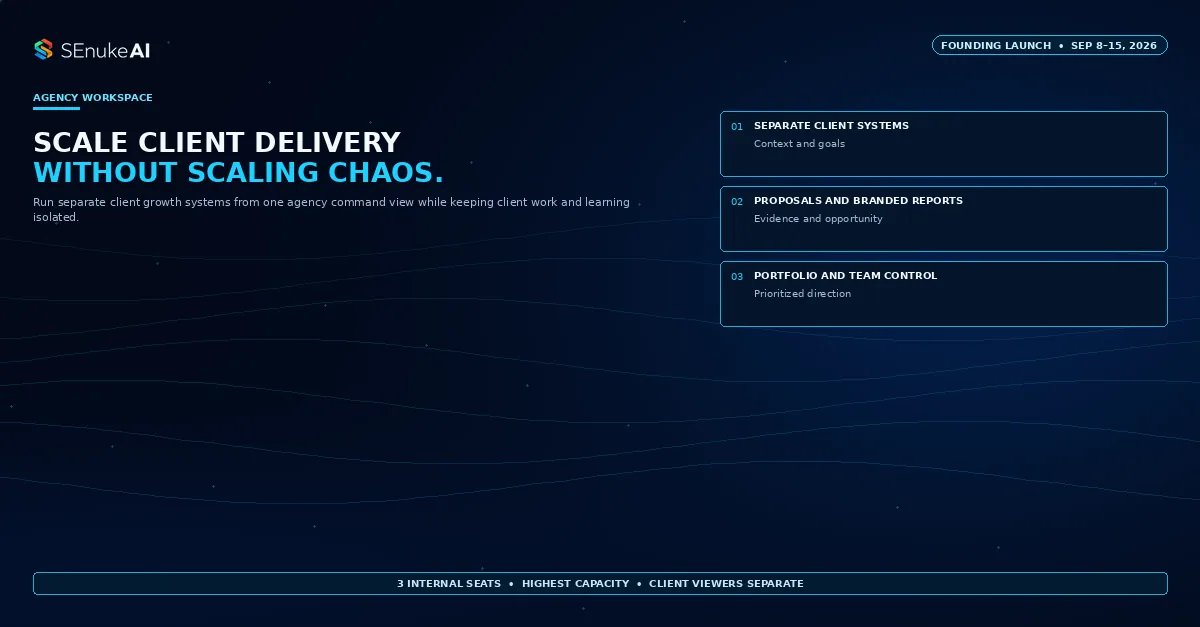
Founding launch: 8–15 September 2026 · opens 8 Sept, 12:00 PM ET · founding pricing closes 15 Sept, 11:59 PM ET
Independent review · hands-on since launch day · Updated 14 Sept 2026
SEnuke AI review: what it is, what it costs, who it's for
It models your business, picks the strongest next move and executes only what you approve. Live since 8 Sept 2026 · founding price from $79/month until 15 Sept, locked while you stay subscribed · I have been inside on the Entrepreneur plan since launch day.
By Benjamin Hübner · marketing digital products since 2007 · used the original SEnuke
The 60-second version
It decides, then asks. Nothing external ships without your approval — Manual is the default.
Every plan is the full platform. $79 / $147 / $497 founding, $97 / $197 / $697 after 15 Sept.
Executes, not just reports. Websites, content, Facebook and Instagram, weekly reports.
Not the old SEnuke. No auto-backlinks. Same founder, new product.
After 48 hours inside: best idea in the category, weakest keyword data, and 4,000 Capacity units go fast. Verdict ↓
Official demo: one Entrepreneur project from setup to a finished WordPress site (demo project, not a live business). Loads when you press play.
My verdict after 48 hours inside
The idea is still the best in its category — decide, approve, execute — but the first impression on the Entrepreneur plan is not worth $79 a month for someone who builds for organic search. The keyword layer underneath the decisions is the weak point: suggestions assembled from my own intake answers, unrelated terms mixed in with no usable filter, CPC and paid difficulty instead of organic metrics, and URL-generated search terms that all show zero searches ("SEnuke AI review services in Australia" is not a query anyone types). Setup is long and confusing, the site scan produced many false positives, and there is no bring-your-own-key option. I threw two real projects in without a careful intake, so part of this may be on me — I am running the full month to see the improvement loop, and this page gets a second verdict on day 30.
Buy the monthly plan if you run a local business or an agency with local clients: the pricing matrix is built around local SEO launch plans, GBP checklists, citation work, white-label audits and client reports, and that is where the platform makes sense. Wait if you need reliable keyword data for organic search — pair a cheaper data tool with your own AI workflow instead (the alternatives). Skip it if you want a one-time purchase, automated link building, or raw data at scale.
What I found
Good
Not good
Capacity / cost
Fully transparent: every chargeable action shows an estimate first, a public price matrix, failed work refunded
4,000 units a month on Entrepreneur is two project setups with nothing left for execution; no bring-your-own-key
Keyword research
Batches are cheap (50–300 units)
Suggestions built from intake text; unrelated terms, no proper filter; CPC / paid difficulty, not organic; URL-generated terms with 0 searches; leans on Search Console
Setup
Guided, evidence sources are the right idea
Long and confusing; a rushed intake produces a generic strategy
Site analysis
Turns findings into an approval-based fix queue
Many false positives on the scan
Output options
Website builds as HTML, WordPress, Shopify export guidance, developer handout or hosted internally
No direct integrations found so far (execution not yet tested)
What the first project actually costs in Capacity
Step
Units
At pack price (≈2.9¢/unit)
AI-assisted intake (analyse website)
125
$3.60
Refresh / reassess opportunities
150
$4.35
Keyword research batches (my four runs)
≈465
$13.50
Generate strategy
450
$13.05
Site crawl
300
$8.70
One project, before any execution
≈1,490 of 4,000
≈$43
Then: AI citation scan 250 · 10-page website build ≈750 · content asset 80 · social calendar 100
Capacity Packs: 1,000 for $29, 3,000 for $69, 10,000 for $199 — non-expiring, but checkout only unlocks at the low-capacity warning
Numbers from my workspace's Capacity Usage History and the live AI Capacity Pricing Matrix, 8–9 September 2026. I burned 1,015 units on two projects before executing a single thing.
Choose
If you are
Entrepreneur, monthly — $79
A local business owner testing it on one project, or anyone who wants to see the loop for a month before judging
Business, monthly — $147
A small team that needs shared context, roles and approvals on one company — capacity allowance still unpublished
Agency, monthly — $497
Managing local clients: isolated Brain per client, white-label audits, local SEO plans, proposals
Annual
Not yet. Nothing in the first 48 hours justifies committing to a year; the founding price locks on monthly too
Strongest idea: the Manual / Assisted / Trusted approval gate. Biggest weakness so far: the keyword data. Everything else is in the detailed analysis below.
Buy through this page and you get 9 bonuses — $1,159 value on every plan, $2,347 on annual, Business or Agency
Full detailed analysis from here down. Everything you need to decide is above. Below: how the loop runs, all twelve screens with screenshots, the approval model, AI search, the comparison, the bonus detail, FAQ, open questions and the 2008–2026 record.
Key facts
Launch
8 September 2026, 12:00 PM ET · founding pricing to 15 September, 11:59 PM ET
Price
$79 / $147 / $497 per month founding, locked while subscribed · $97 / $197 / $697 after · annual = 10 months
JVZoo · affiliate links on this page, 30% recurring on monthly plans (20% on annual) to me
Method
Vendor site and partner page, JVZoo listing, official demo video, 17 official screenshots, 2008–2026 record. Hands-on on the Entrepreneur plan since 8 September (two real projects). Last verified 9 September 2026.
What SEnuke AI actually is — and how the Continuous Growth Loop runs
A subscription platform that understands your business, finds opportunities, builds a strategy, executes the work you approve, measures what happened and decides what to do next — then repeats. The vendor calls it an AI Growth Operating System. Stripped of branding: it tries to run the whole decision chain behind marketing work, not one slice of it.
Most marketing software
Picks a slice. Semrush and Ahrefs give you data. Surfer optimises a page you already chose. Jasper writes copy for a brief you already made. All of them assume you have answered the hardest question: what deserves to be done at all?
SEnuke AI
Aims at that question. Builds a picture of your business first, works out where the opportunity is, proposes a plan — and only then executes, and only what you approve. The vendor's line: "Executing the wrong thing faster isn't a growth strategy."
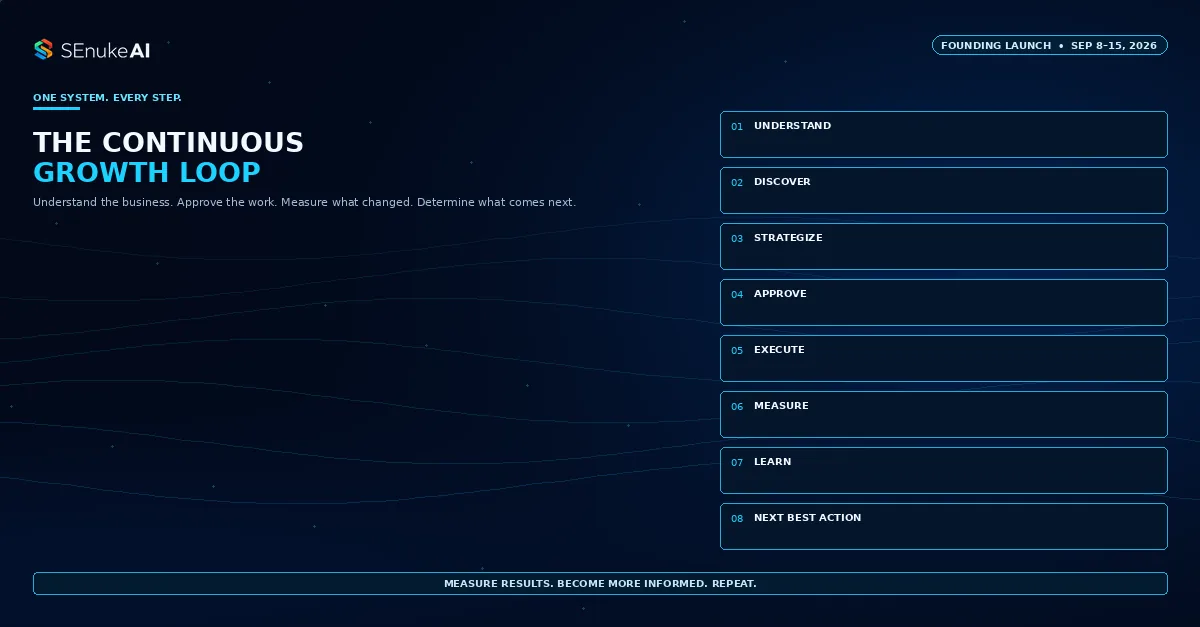
The loop: nine steps, running continuously
1
Understand
Business, audience, goals and available evidence.
2
Discover
Opportunities, gaps and constraints you are not currently serving.
3
Strategize
A prioritised Growth Blueprint rather than a list of tactics.
4
Approve
You decide what runs. Nothing goes live on its own.
5
Execute
The approved work, coordinated across channels.
6
Measure
Performance tied to business outcomes, not vanity metrics.
7
Learn
Evidence retained across the system so it compounds.
8
Next Best Action
The strongest move to consider now, given everything known.
9
Repeat
The loop runs again with more context than last time.
The Continuous Growth Loop as the vendor draws it. Official launch graphic.
Two things matter more than the diagram. The vendor says the platform keeps monitoring "even between logins" and has published the schedule, which makes it testable rather than a slogan. And the loop is an old idea in new software — OODA and plan-do-check-act with an AI doing "observe" and "plan". The question is whether the observing is good. Why the shape matters commercially: HBR found only 55% of managers can name one of their company's top five priorities; CoSchedule found marketers with a documented strategy are 414% more likely to report success. A loop that forces "strategise" and "approve" before anything ships is aimed at that gap.
What it does after the project is done
Daily
System checks: site up, forms and lead delivery, tracking, integrations, rankings, reviews, running experiments. Breakage is flagged immediately.
Weekly
Performance analysis across traffic, leads, search, AI-citation visibility, local, reviews, backlinks — then it keeps, updates or replaces the current Next Best Action.
Monthly
The full growth system: funnel drop-offs, content decay, coverage gaps, competitor movement, progress to goals, next month's top opportunities.
Quarterly
The assumptions: goals, audiences, offers, positioning, channel priorities. If the evidence says something changed, the strategy changes.
Every approved action is scored at 7, 14 and 30 days — completed correctly, did traffic or leads move, did search and AI visibility improve, continue / improve / stop. Event-triggered reviews fire on a broken form, a tracking outage, a keyword jump, a reputation risk or a competitor move. All of this is a published promise, not yet a demonstrated one; the two things I test in week one are whether the daily check catches a broken form on a test site and whether the weekly analysis actually changes the Next Best Action.
Want to see where your own loop has a gap before spending anything? The free Growth Gap Scanner scores these stages in about 90 seconds, no email needed.
Inside the platform: the twelve screens, with screenshots
The official walkthrough (at the top of this page) follows one Entrepreneur project — a roofing business in Maine, a demonstration project, not a live client — from setup through research, strategy, approvals and a finished WordPress site. Three things it confirms: Entrepreneur is not a cut-down version (tiers differ by seats and capacity, not intelligence); WordPress is one output, not the only one (static HTML or a handoff package for an existing site, no lock-in); and completion starts the loop rather than ending it. Everything below is checked against the video and the official screenshots.
01Guided Project Setup
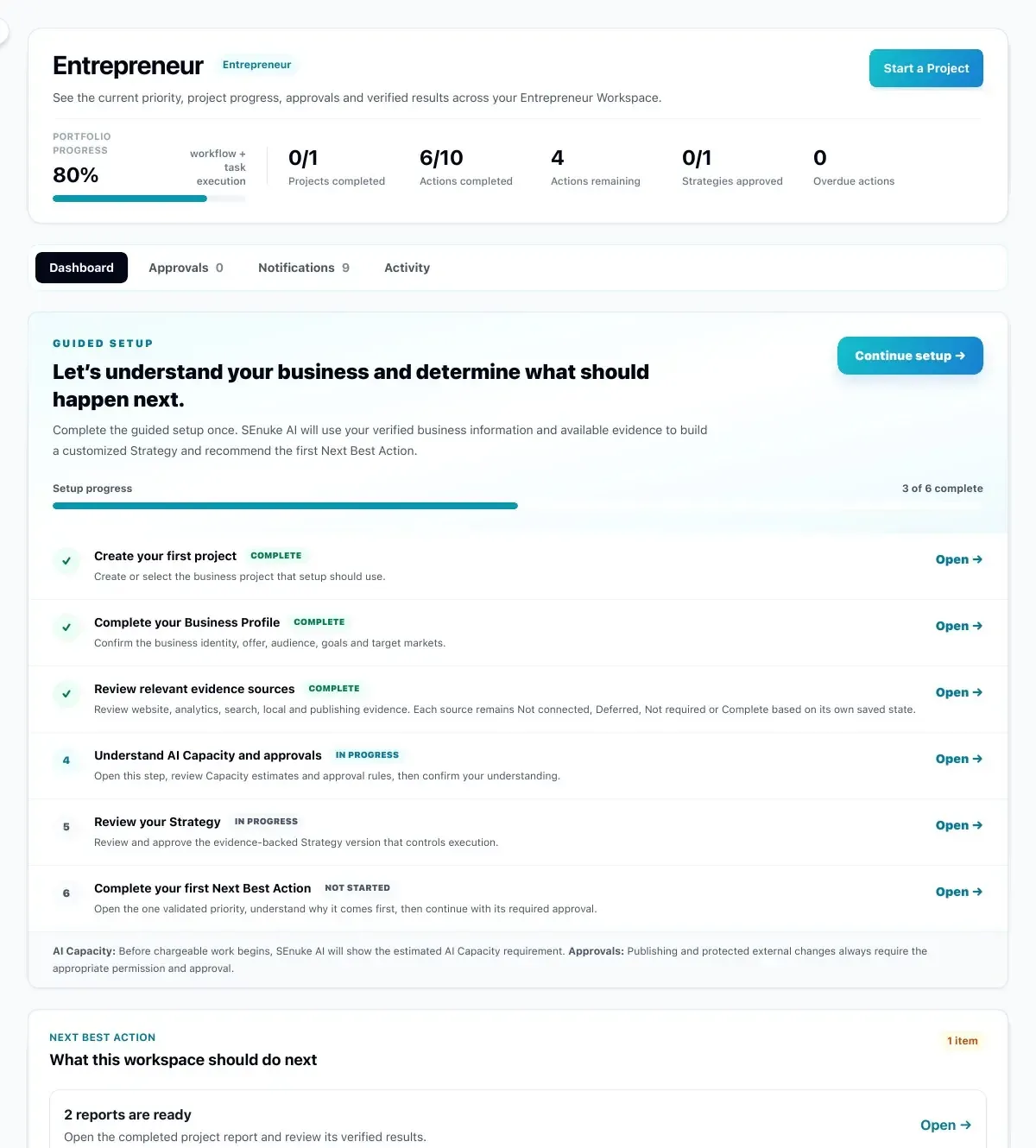
A six-step onboarding: create the project, complete the business profile, review evidence sources (website, analytics, search, local, publishing — each marked Not connected, Deferred, Not required or Complete), understand AI Capacity and approvals, review the strategy, complete the first Next Best Action. The workspace dashboard shows portfolio progress, projects and actions completed, strategies approved and overdue actions.
Note from the screenshot: "Before chargeable work begins, SEnuke AI will show the estimated AI Capacity requirement." Capacity is a metered unit — see pricing.
Guided setup, Entrepreneur workspace. Six steps, progress bar, and the Next Best Action panel underneath. Official screenshot.
02Project Control
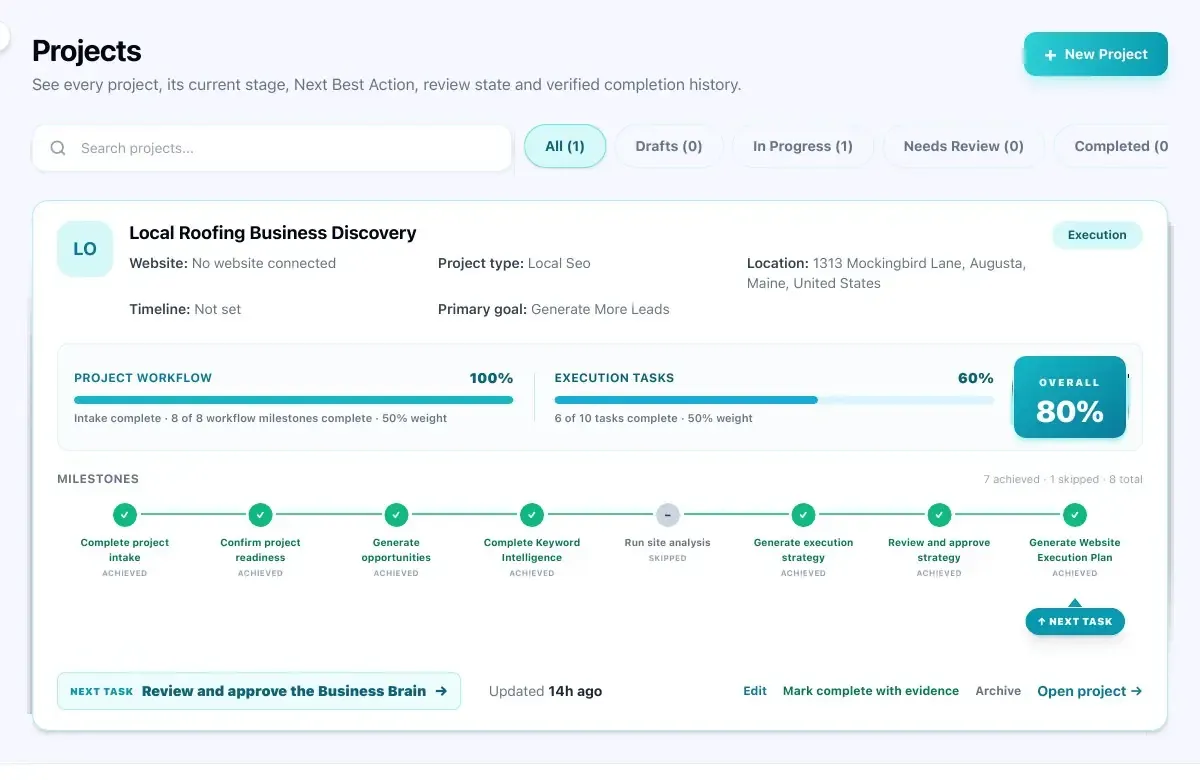
One row per project: website, type, location, primary goal, an eight-milestone workflow (intake → readiness → opportunities → keyword intelligence → site analysis → execution strategy → approval → website execution plan), execution-task progress and the next task. The demo shows workflow 100% complete and execution 60%, overall 80%.
03Opportunity Intelligence
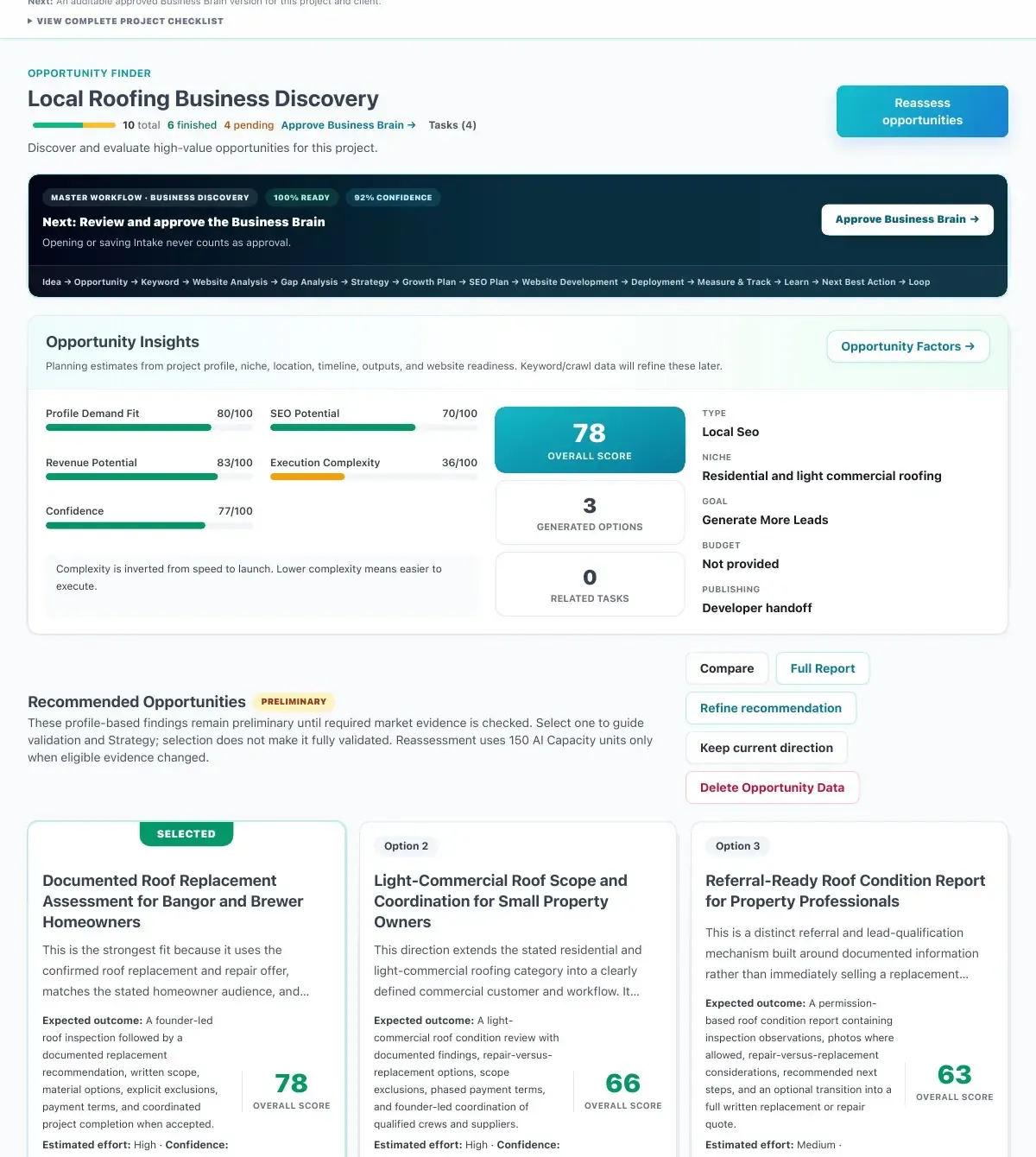
Scores the business on Profile Demand Fit, SEO Potential, Revenue Potential, Execution Complexity and Confidence, then generates three candidate directions with an overall score each — in the demo, a documented roof-replacement assessment (78), a light-commercial scope service (66) and a referral-ready condition report (63) — with expected outcome and estimated effort. Findings are labelled "preliminary until required market evidence is checked".
Reassessment "uses 150 AI Capacity units" per the screenshot — the first concrete capacity number anywhere.
Opportunity Intelligence. Five sub-scores, three generated options, one selected. Official screenshot.Project Control. Eight milestones, workflow and execution progress, next task. Official screenshot.
04Keyword Intelligence
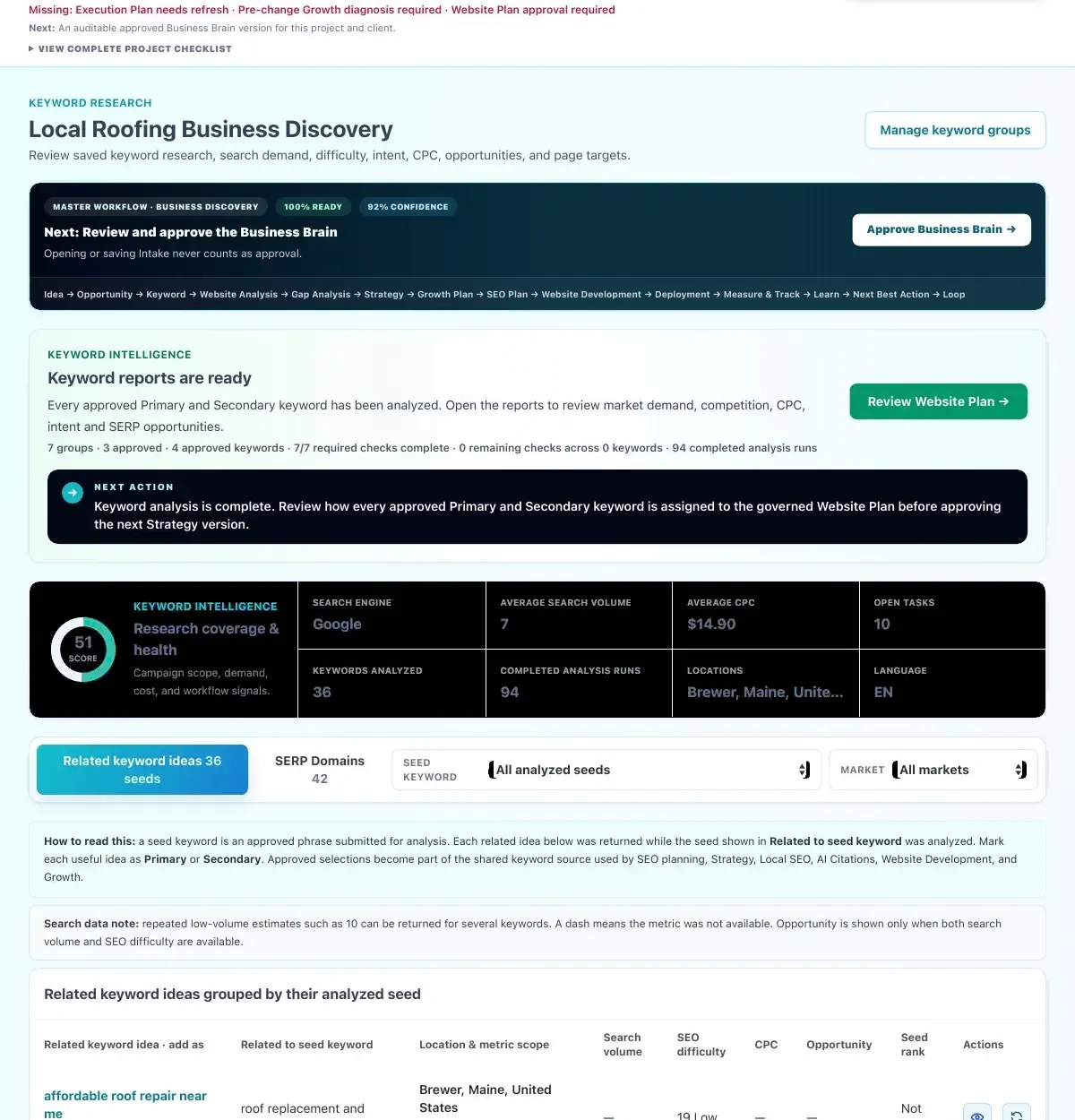
Seed keywords are expanded into related ideas with search volume, SEO difficulty, CPC and an opportunity rating, grouped by seed and scoped to a location. The demo header shows search engine Google, 36 keywords analysed, 94 completed analysis runs, 42 SERP domains, average CPC $14.90. Approved keywords feed the Website Plan.
Data source shown as "Search engine: Google". Whether a third-party index sits behind the volume and difficulty numbers is still not stated.
05Strategy and Decision Engine
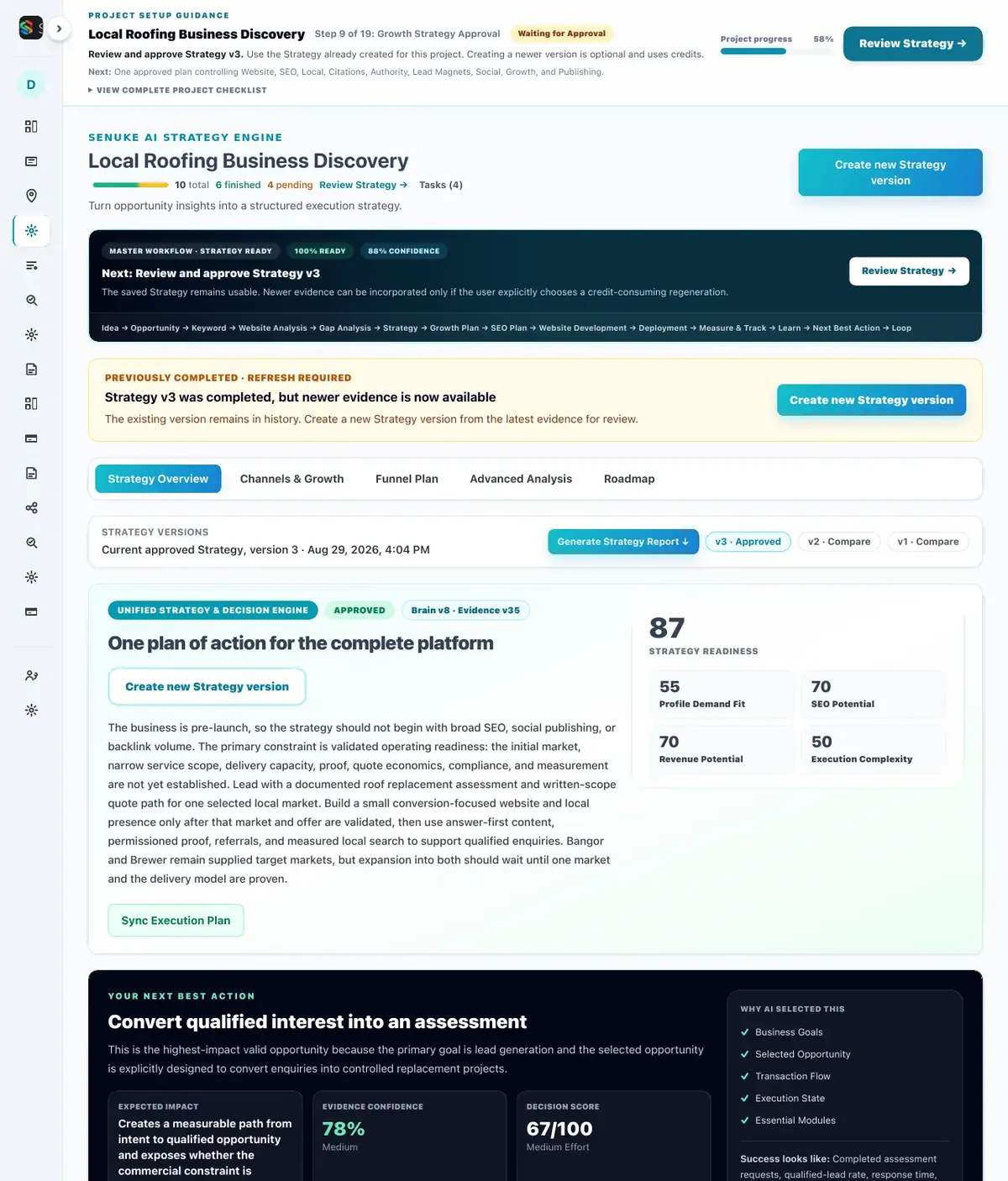
Produces one plan for the whole platform with a Strategy Readiness score (87 in the demo), sub-scores for demand fit, SEO potential, revenue potential and execution complexity, a written strategic direction, and a Next Best Action with a "Why AI selected this" panel listing the business goals, selected opportunity, transaction flow and execution state it used. Strategies are versioned (v1, v2, v3 with compare) and a new version is only generated when you explicitly choose a "credit-consuming regeneration".
Keyword Intelligence. Google search data, 36 keywords analysed, related ideas grouped by seed. Official screenshot.Strategy and Decision Engine. Readiness 87/100, versioned strategy, Next Best Action with reasoning. Official screenshot.
06Connected Growth Intelligence (Search & Growth)
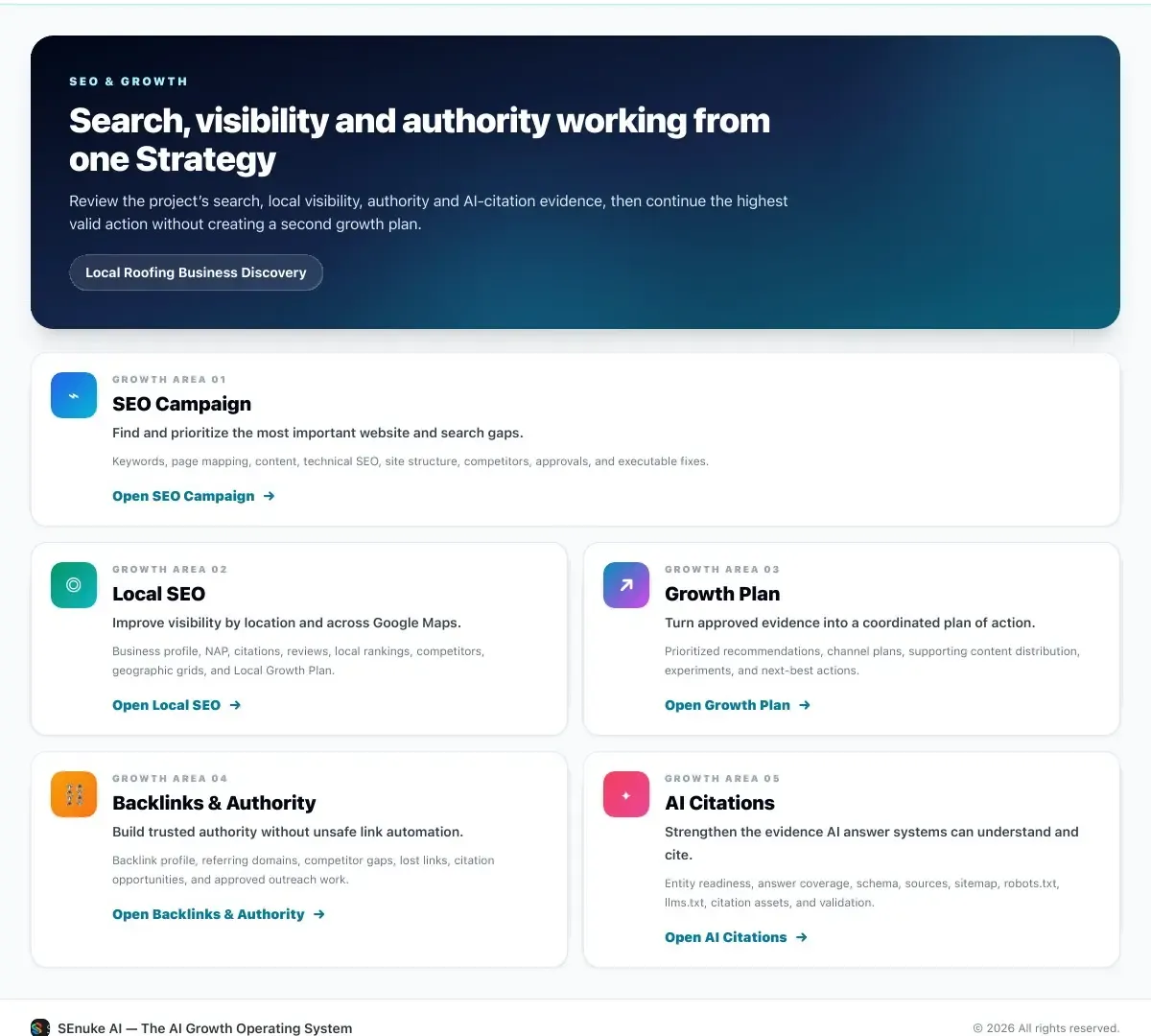
Five growth areas working from the same strategy: SEO Campaign, Local SEO, Growth Plan, Backlinks & Authority ("build trusted authority without unsafe link automation" — the vendor's own words on the screen) and AI Citations, which covers entity readiness, answer coverage, schema, sources, sitemap, robots.txt, llms.txt, citation assets and validation.
That AI Citations list is the most concrete description yet of what the AI-search module does. Whether it also measures citations across engines, or only prepares the site for them, is still unclear.
Search & Growth. Note "without unsafe link automation" under Backlinks & Authority. Official screenshot.
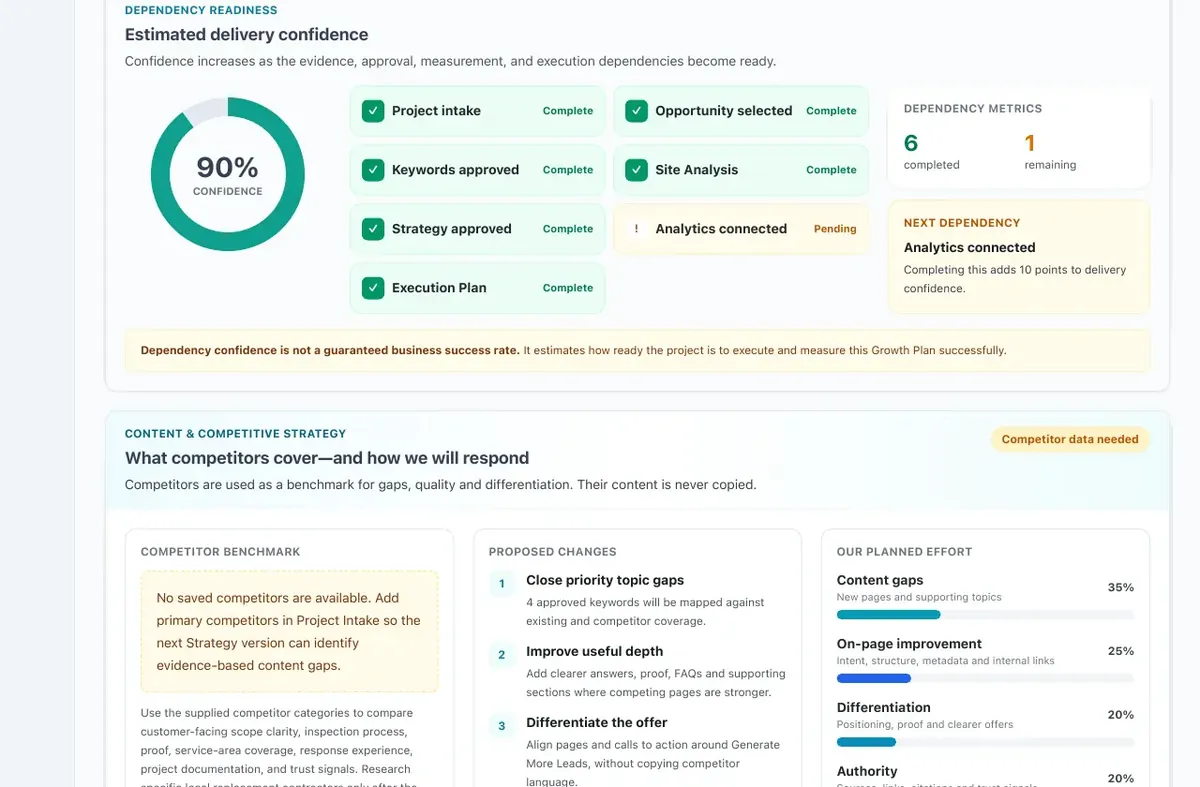
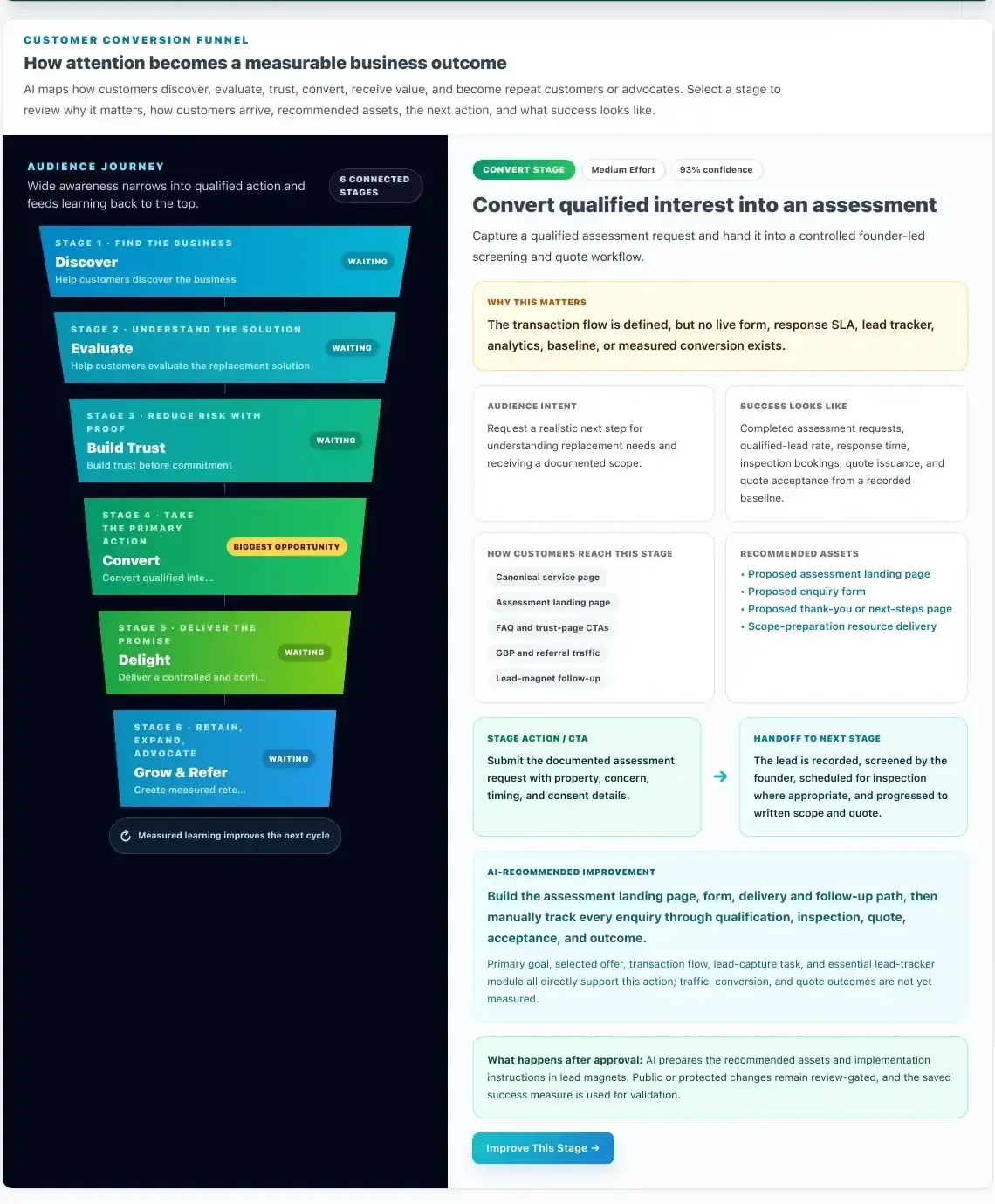
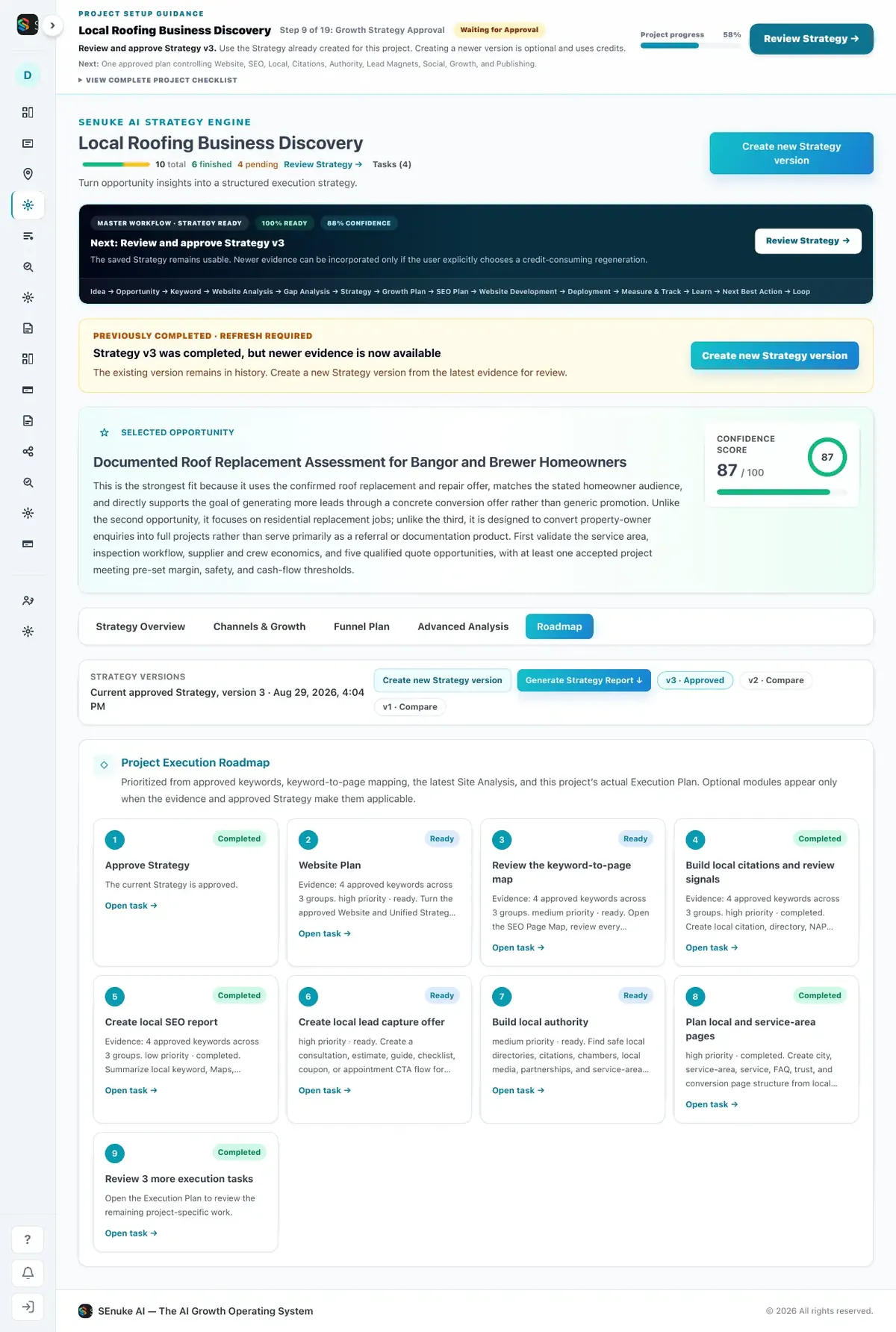
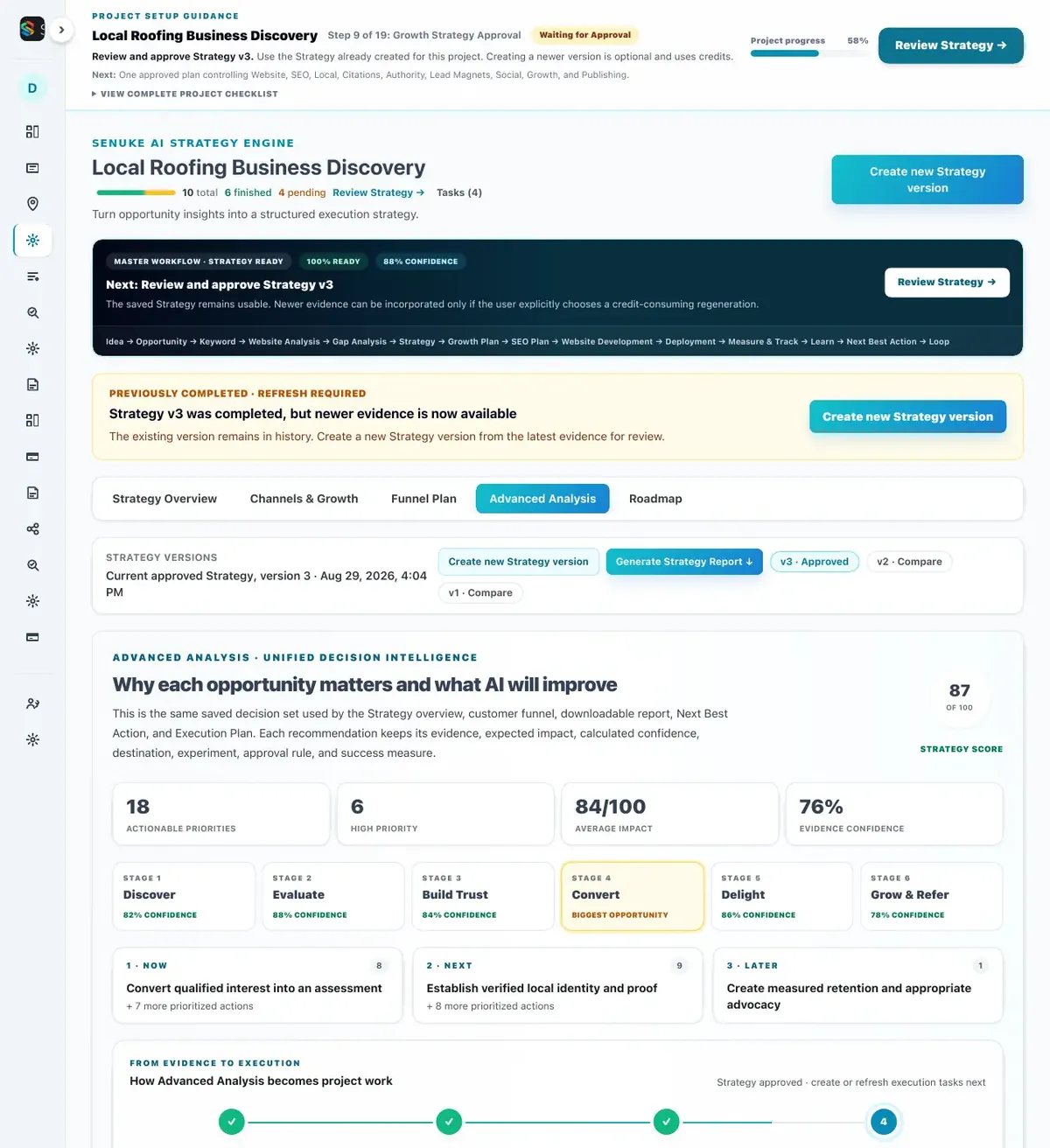
Five tabs on the approved strategy. Channels & Growth ranks effort by channel (demo: SEO 96, Content 92, Authority 82, Local 76, Social 74) and shows an "estimated delivery confidence" with dependency checks — intake, opportunity, keywords, site analysis, strategy, execution plan, and analytics connected. Advanced Analysis lists actionable priorities by funnel stage (demo: 18 priorities, 6 high, 84/100 average impact, 76% evidence confidence). The Funnel Plan maps the customer journey stage by stage with a confidence figure and a recommended improvement. The Roadmap turns it into ordered tasks: approve strategy, website plan, keyword-to-page map, local citations.
The confidence gauge carries its own disclaimer: "Dependency confidence is not a guaranteed business success rate." Good.
Roadmap. Strategy into ordered tasks with status. Official screenshot.
Website Creation, Revision and Optimisation
Creates a new WordPress or static HTML site from the strategy, or analyses and improves the one you have, optimised for SEO, AEO, GEO and conversion. The demo video builds a WordPress site. The vendor's 5 September update is explicit that this is delivered as a handoff: "organized website files and approved assets as a handoff package ready for upload or implementation." You choose the format.
So "execute" for websites means prepare and deliver, not push to your host. That is the right call for safety and the wrong expectation if you thought it would publish for you.
08Social and Distribution
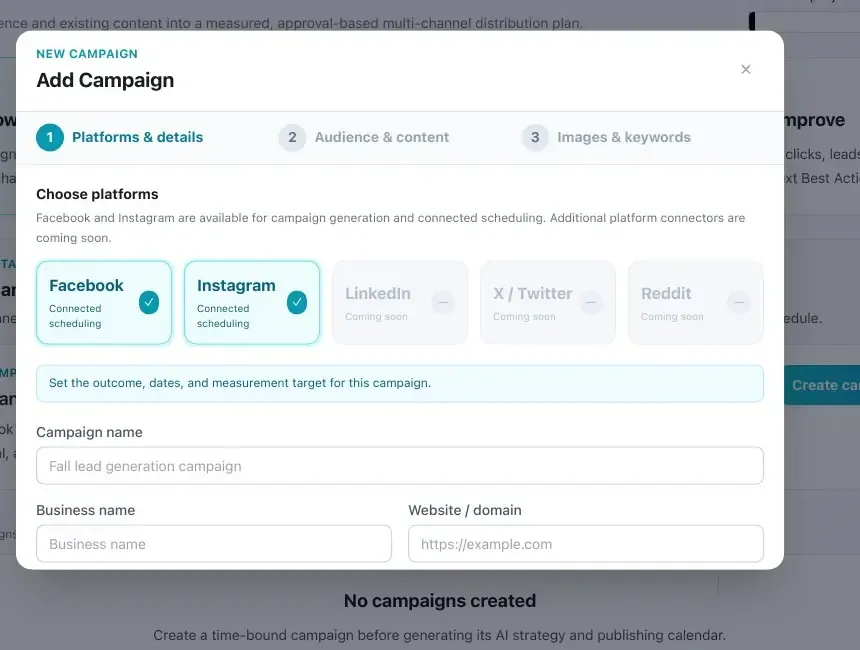
Three steps: build the growth-aligned campaign plan, approve/schedule/publish, measure and improve. Campaigns are time-bound with dates, topics, keywords and frequency; the AI prepares posts and images for preview and approval.
The screenshot answers an integration question: Facebook and Instagram are connected for scheduling; LinkedIn, X/Twitter and Reddit are "coming soon".
Social campaign setup. Facebook and Instagram connected; LinkedIn, X/Twitter, Reddit coming soon. Official screenshot.
09Approval Center
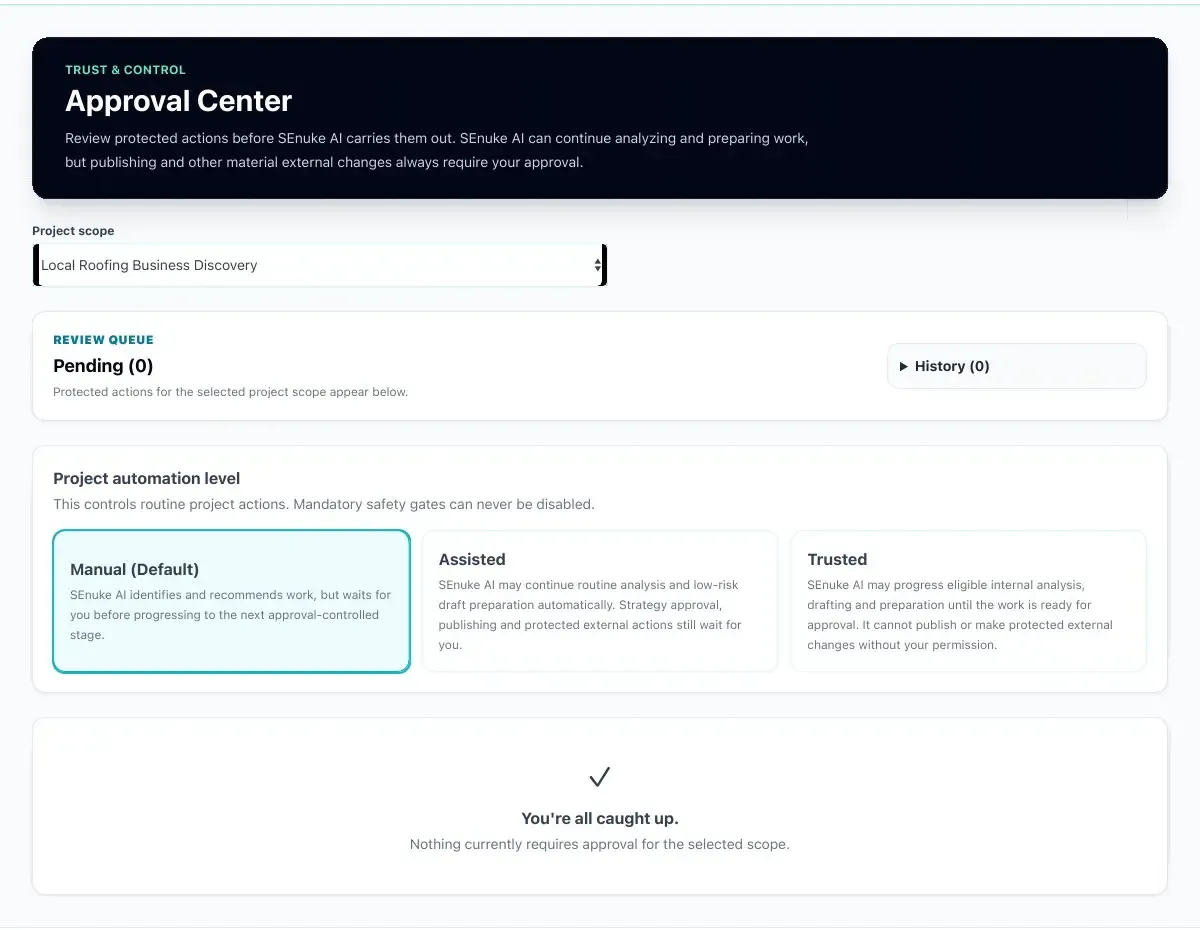
Where you choose Manual (the default), Assisted or Trusted automation per project, with a review queue and history. Detailed in the next section.
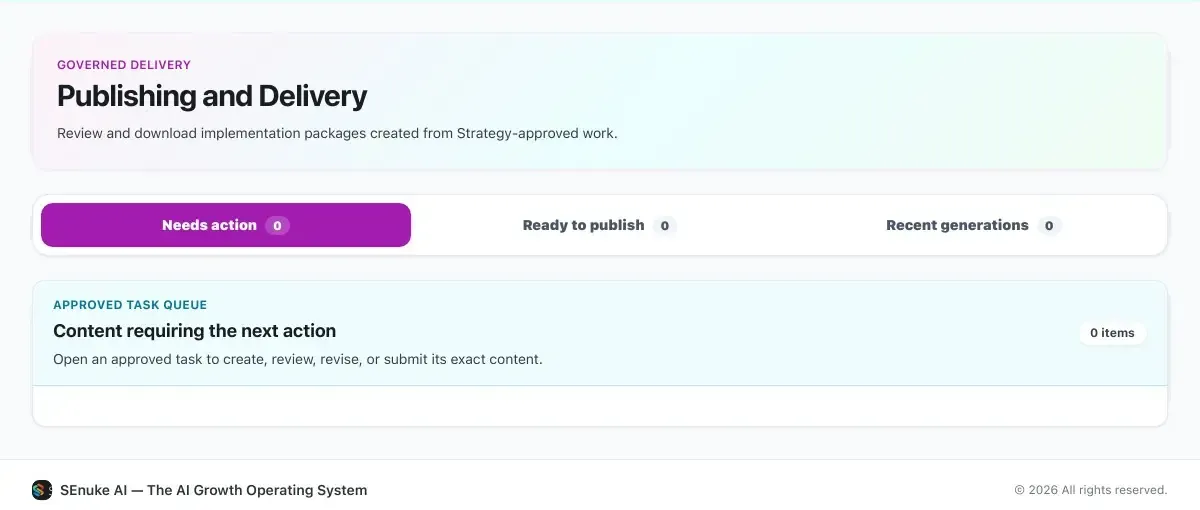
10Publishing and Delivery
A governed delivery queue with three states — Needs action, Ready to publish, Recent generations — described on screen as "review and download implementation packages created from Strategy-approved work".
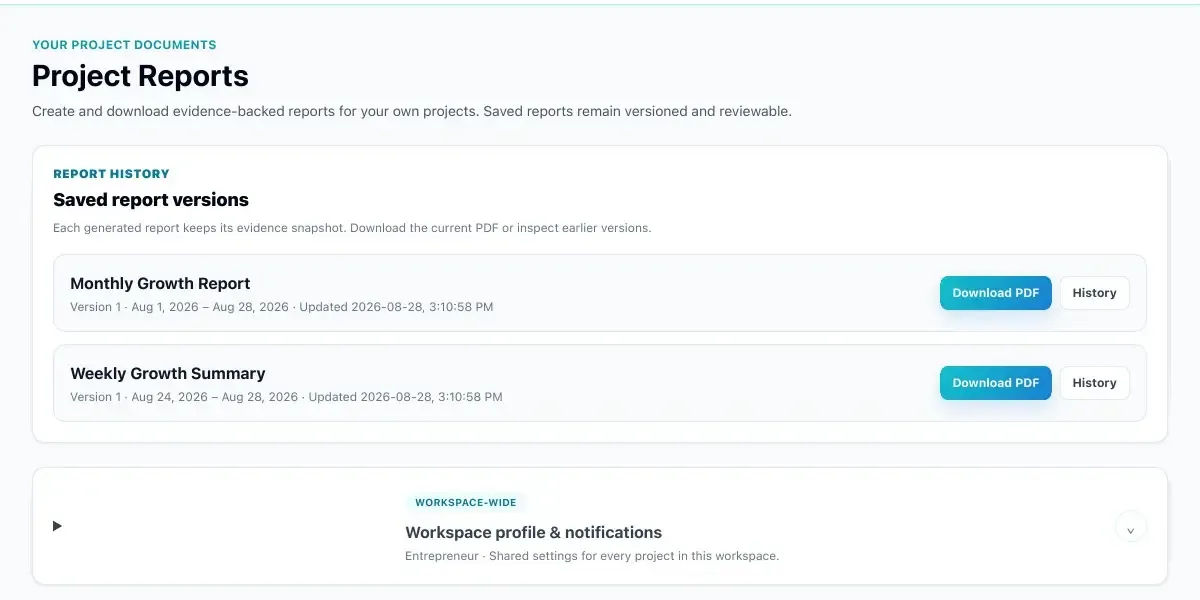
11Measurement and Learning (Project Reports)
Weekly Growth Summary and Monthly Growth Report, each versioned with history, downloadable as PDF. Entrepreneur includes on-screen reports and PDF export; Business adds consolidated team reporting; Agency adds branded client reports.
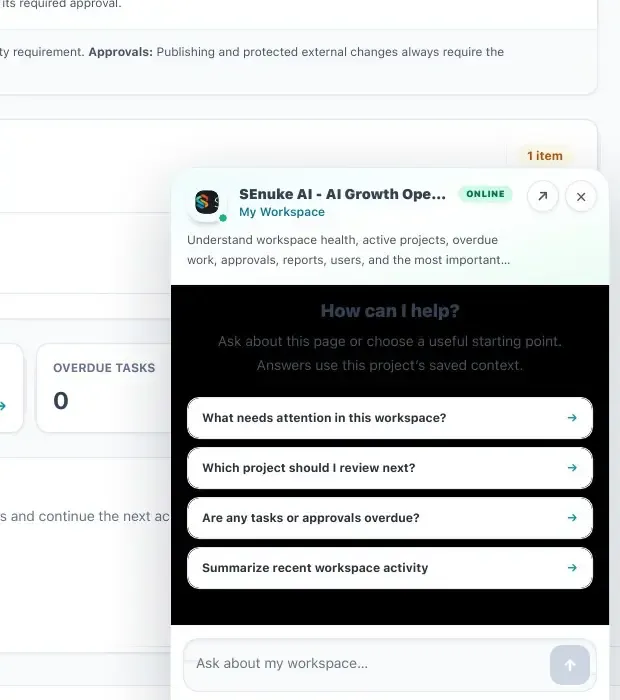
12Integrated Guidance
A chat assistant that already knows the workspace: "What needs attention in this workspace?", "Which project should I review next?", "Are any tasks or approvals overdue?", "Summarize recent workspace activity." Answers use the project's saved context.
Advanced Analysis. 18 actionable priorities, 6 high priority, 84/100 average impact, 76% evidence confidence. Official screenshot.
Publishing & Delivery. Needs action / Ready to publish / Recent generations.Project Reports. Weekly and monthly, versioned, PDF download.
Integrated Guidance. Answers use the project's saved context. Official screenshot.
The Agency workspace
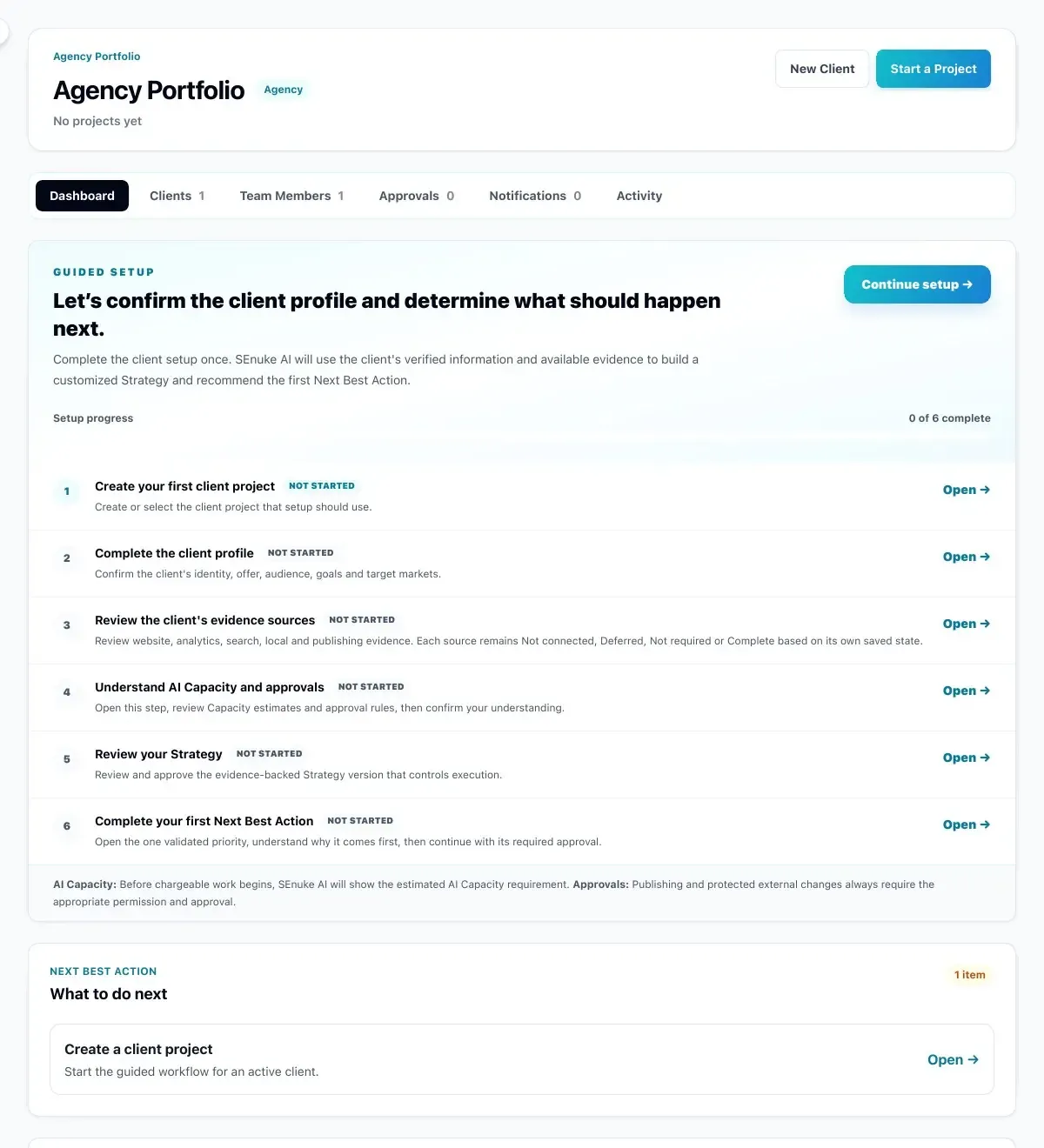
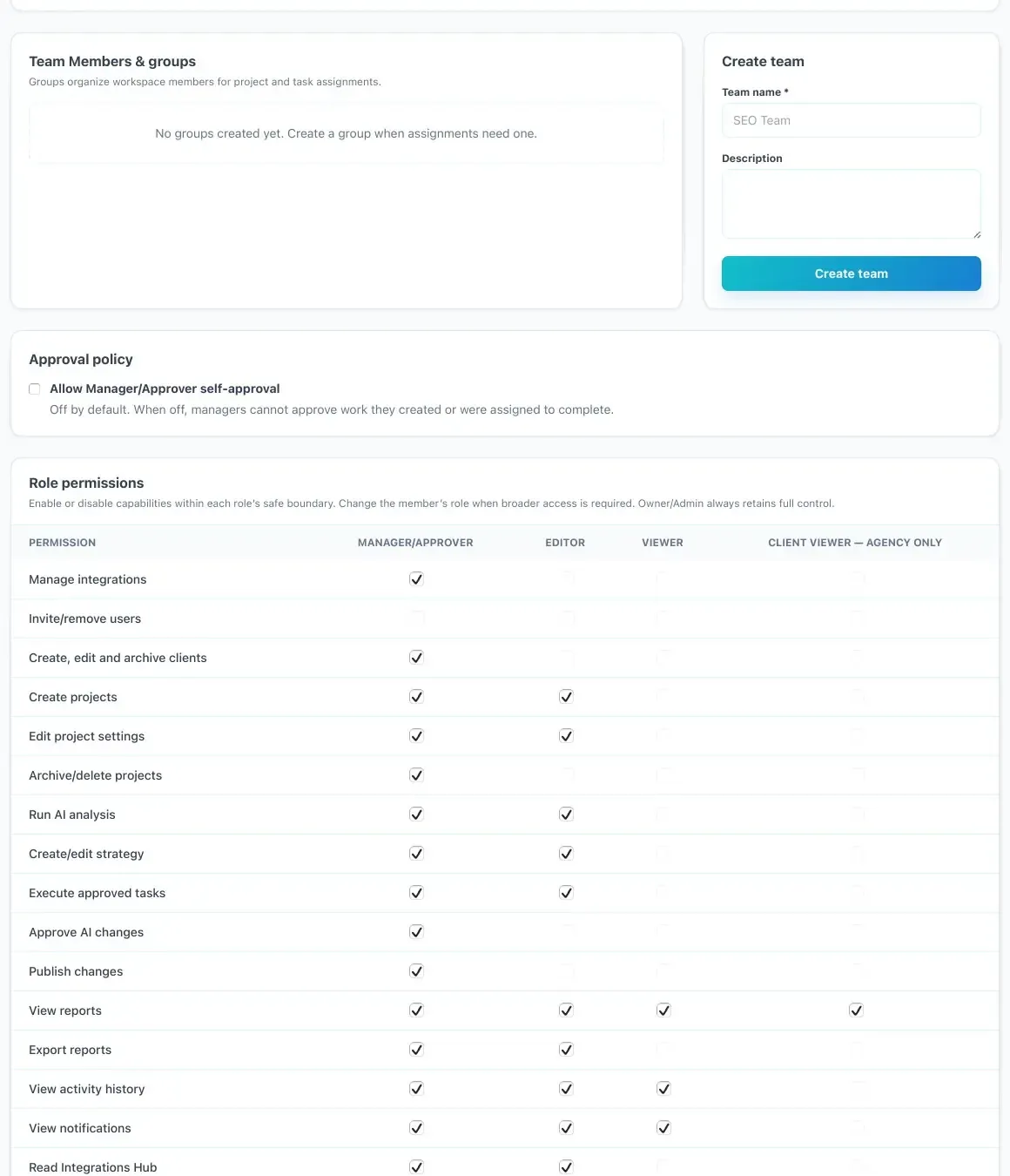
Agency accounts add an Agency Portfolio (clients, team members, approvals, notifications, activity), an isolated Business Brain per client, Client Viewers that are separate from internal seats, White Label PDF reporting and a Proposal Builder. The permissions screen shows four roles — Manager/Approver, Editor, Viewer and Client Viewer — with a matrix covering integrations, users, clients, projects, AI analysis, strategy, executing approved tasks, approving AI changes, publishing, reports and activity. One detail I like: "Allow Manager/Approver self-approval" is off by default, so the person who created a task cannot approve it unless you turn that on.
Agency Portfolio. Guided client setup, six steps per client.Agency permissions. Four roles; self-approval off by default.
The Approval Center: Manual, Assisted, Trusted
This is the section I would read twice if I were buying. The single most important design decision in SEnuke AI is not the AI — it is where the human sits. The platform offers three automation levels, and the vendor's own descriptions are worth quoting exactly:
Manual
"You review and control each important step."
Assisted
"SEnuke AI prepares the work and brings it to you for approval."
Trusted
"Approved work can move forward within the permissions and safeguards you set."
Approval Center. Manual is the default. The screen states: "Mandatory safety gates can never be disabled." Official screenshot.
Two details from the screenshot the tour does not mention. First, Manual is the default — you have to opt up, not opt down. Second, the automation level "controls routine project actions", and the screen says in so many words that "mandatory safety gates can never be disabled": even at Trusted, publishing and protected external changes still wait for approval. On Business and Agency plans this sits on top of role permissions (Manager/Approver, Editor, Viewer), and self-approval by the person who created the work is off unless you enable it.
Note what Trusted does not say: it does not say "fully autonomous". Even at the top level, publishing, outreach and external changes are described as respecting your approvals, roles, permissions and safeguards. The partner FAQ answers the direct question "Does SEnuke AI execute without approval?" with a one-word "No."
Why this matters more than any feature: the data on autonomous marketing agents in 2026 is not kind.
40%+
of agentic AI projects will be cancelled by end of 2027, mostly for cost, unclear value and inadequate risk controls
Gartner, June 2025
45%
of martech leaders with agents in pilot or production say vendor-offered AI agents fail to meet expectations
Gartner survey of 413 martech leaders, Oct 2025
8%
of CMOs run campaigns where multiple AI agents operate autonomously; 42% use GenAI only to assist humans on individual tasks
BCG, 300 CMOs, June 2026
61%
of large US companies with agents deployed now have formal approval processes; 66% have monitoring dashboards
KPMG AI Pulse, June 2026
And the capability benchmarks explain why. Salesforce's own CRMArena-Pro benchmark put the best LLM agents at roughly 58% success on single-turn business tasks and about 35% on multi-turn ones. An August 2026 paper from researchers at Hugging Face and Data & Society documents "approval fatigue" — people rubber-stamping agent actions without reading them — and recommends exactly the kind of deliberate friction SEnuke AI's Manual and Assisted modes are.
My read: a growth platform that wants you to start in Manual, earn its way to Assisted, and only then be Trusted is designed by someone who has watched agents fail in production. That is the opposite of most 2026 launch copy. It is also the reason this is sellable to an agency with client accounts at stake, not only to a solo experimenter. If you run client work, the Approval Center is the feature — everything else is the payload it protects.
If the approval gate is the feature you needed, start on Manual and see one full loop before you trust anything.
Practical advice for week one, regardless of plan: leave everything on Manual until you have seen at least one full loop — setup, blueprint, one approved action, one measured result — and only then move individual work types to Assisted.
AI search visibility: the feature I'd watch most closely
AI Citation intelligence is inside the base platform. In 2026 that is not a throwaway feature:
68%
of Google searches in the US now end without a click to any website, up from 60% in 2024
SparkToro / Similarweb clickstream, Jan–Apr 2026
58%
of the clicks that used to go to the #1 result are now kept by Google when an AI Overview appears
Ahrefs, 300,000 keywords, May 2026
12%
of URLs cited by ChatGPT rank in Google's top 10 for the same query — AI citation and ranking are different games
Ahrefs, Aug 2025
0.66
correlation between brand web mentions and AI Overview visibility, versus 0.22 for referring domains
Ahrefs, 75,000 brands, Aug 2025
Every major SEO vendor sells this separately: Ahrefs Brand Radar from $199/mo, Semrush's toolkit $99/mo as an add-on, Surfer $158, Profound $99, Writesonic $79. SEnuke AI's $79 plan includes it. If the module holds up, it replaces a $99–$199 line item on most SEO stacks; if it is a token gesture, the comparison collapses. First thing I test on launch day. One caution the data gives for free: brand mentions off your own site drive AI visibility far more than backlinks — the platform can show where you are not cited; getting cited is still work. Deeper dive: AI search visibility in 2026.
SEnuke AI pricing, seats and what a year really costs
SEnuke AI costs $79, $147 or $497 per month, or $790, $1,470 or $4,970 per year. The annual option is twelve months for the price of ten. Every plan includes the complete platform; the difference is operating capacity, number of projects and clients, and seats.
Grow my business
Entrepreneur
$79/month
or $790/year — saves $158
After the founding launch: $97/month or $970/year
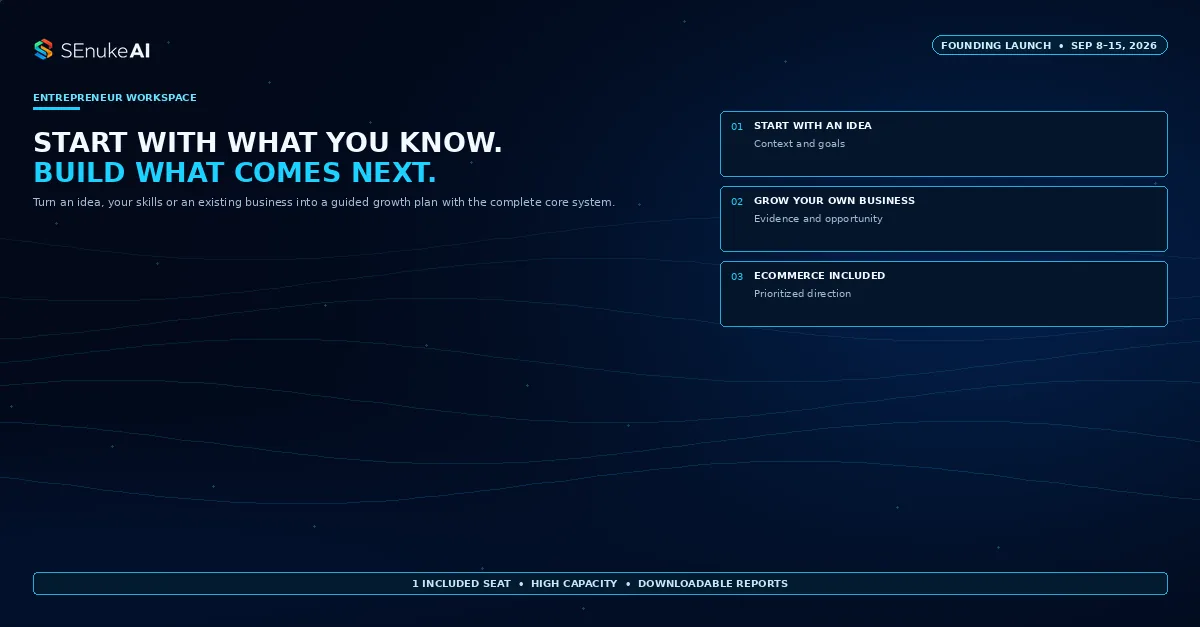
1 seat (owner only). "High capacity": 4,000 AI Units a month (sales page, 10 September; matches my workspace). For an individual starting, building or growing a business from an idea, expertise, an existing brand, an ecommerce store or a marketplace presence. Complete strategy and approved execution, weekly and monthly growth summaries, SEO/AEO/GEO/website/measurement reports, on-screen reports and PDF export.
Grow our business · Most popular
Business
$147/month
or $1,470/year — saves $294
After the founding launch: $197/month or $1,970/year
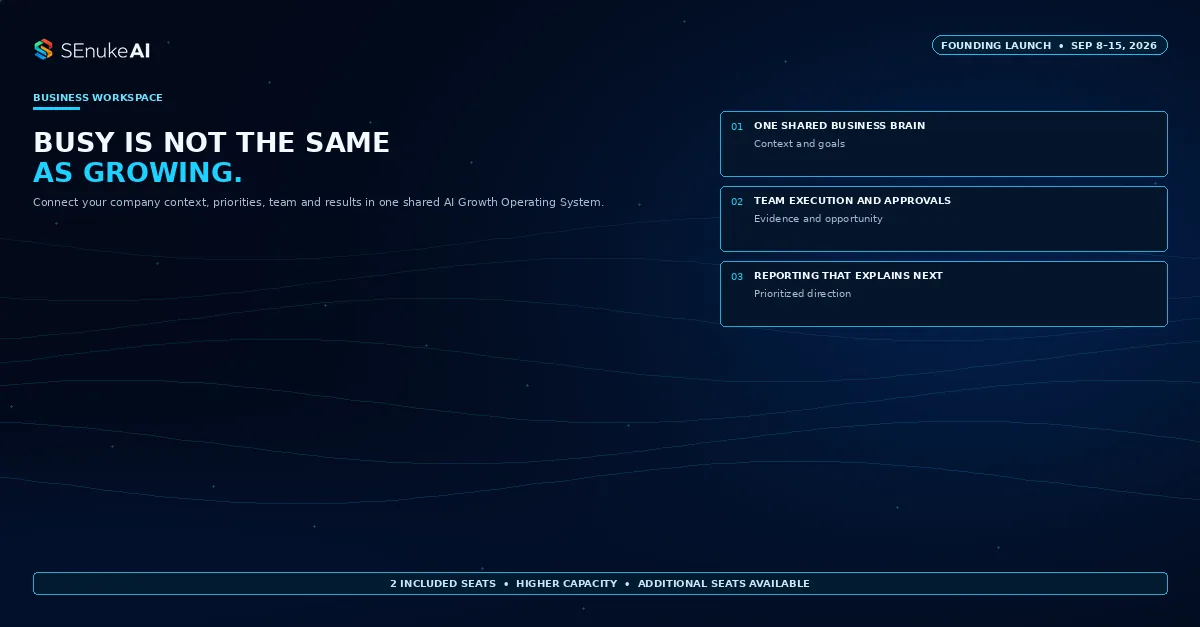
2 seats (owner plus one team member), additional seats available. "Higher capacity": 10,000 AI Units a month (sales page, 10 September). Everything in Entrepreneur plus a shared Business Brain, roles and permissions, approval workflows with execution accountability, and consolidated business and team reporting.
Grow our clients' businesses
Agency
$497/month
or $4,970/year — saves $994
After the founding launch: $697/month or $6,970/year
3 internal seats (owner plus two team members), additional seats available, plus Client Viewers that don't count against internal seats. "Highest capacity": 36,000 AI Units a month (sales page, 10 September). Everything in Business plus isolated client intelligence, strategy and reports, agency-branded reports, portfolio oversight and the Proposal Builder.
What twelve months actually costs
Plan
Founding, monthly × 12
Founding, annual
Standard, monthly × 12
Standard, annual
Entrepreneur
$948
$790
$1,164
$970
Business
$1,764
$1,470
$2,364
$1,970
Agency
$5,964
$4,970
$8,364
$6,970
Founding prices are locked for as long as the subscription stays active and in good standing. Seat add-on pricing has not been published.
Refund / guarantee: 14 days on the first payment of a new subscription, per the JVZoo order page and the senuke.com Terms of Service (section 22); renewals, partially used periods, AI Capacity top-ups and extra seats are not refundable. JVZoo is the retailer. Free trial: none announced. Billing: monthly or annual subscription, no contract stated; founding price locked while active. AI Capacity: Entrepreneur gets 4,000 units a month; one project setup costs about 1,490 before any execution; packs are $29 per 1,000 (checkout unlocks only at the low-capacity warning). Budget a pack if you run more than two projects. Agency is not the upgrade from Business: different buyer path, every plan has the full platform.
If you fit the local-business or agency profile, founding pricing is worth taking this week: $79 locked for as long as you stay, versus $97 from 16 September. If you do not fit, $18 a month is not a reason to buy a tool that does not match your work — wait for my day-30 verdict.
SEnuke AI pays affiliates 30% recurring on the monthly plans and 20% on the annual plans; if you subscribe through my links I earn that. Your price does not change.
How SEnuke AI compares
Prices checked on each vendor's pricing page, 7 September 2026. It does not win every row — it competes on a different axis.
Platform
Cheapest full plan
AI search visibility
What it's built to do
SEnuke AI
$79/mo
Included (AI Citation intelligence)
Runs the whole loop: understand, strategise, approve, execute, measure, decide next action
Semrush
$139/mo (SEO)
+$99/mo add-on, or $199/mo Starter bundle
Deep research data and the industry-standard index; AI features spread across modules
On-page content optimisation — makes a page better, doesn't decide which page to make
Writesonic
$79/mo
Core product
AI search visibility tracking across ChatGPT, Perplexity and Google AI
GoHighLevel
$97/mo
—
Agency CRM, funnels and automation — the execution layer, without a strategy brain
HubSpot Breeze agents
Pro/Enterprise hubs + per-outcome fees
—
Task agents priced per result ($0.50 per resolved conversation, $1 per lead); needs the HubSpot stack around them
Jasper
$69/seat/mo
—
Brand-voice content generation; assumes you already know what to write
"Cheapest full plan" = lowest tier with the core product, not a like-for-like feature match.
The fair caveat: Semrush and Ahrefs have fifteen years of index depth; for raw keyword and backlink data at scale they are still the answer. SEnuke AI competes on the layer above the data — deciding what it means and what to do — and that layer is underserved at $79. Row by row: all alternatives · vs Semrush · vs GoHighLevel · for agencies.
Different axis, lower price: the monthly Entrepreneur plan at $79 is the sensible test — and my 9 bonuses come with it.
Built around the gaps in the loop: real evidence in, finished assets out, the seat paying for itself. Five for every buyer, four more on annual, Business or Agency. Full detail on the bonus page →
$1,1595 bonuses, every buyer, any plan
+ $1,1884 more on annual, Business or Agency
$2,347everything, annual or higher
Every buyer: 5 bonuses, $1,159
🔍
1. Revenue Leak Finder Every buyer$197 value
Chrome extension
Find what is costing you sales on any page — in 90 seconds, with a report that carries your logo.
33 checks, 8 categories, real numbersSame page, same score, every time — findings a client can rerun
AI layer (your key): promise-vs-proof, objections, hesitation wordingTells you why the page leaks, not just where
Every AI finding must quote the page; never invents revenueNothing indefensible reaches a client
3. Business Brain Dossier + AI skill Every buyer$197 value
Prompt system + installable skill
One 60–90 minute session that makes the platform actually understand your business — extract, don't invent.
12 extraction prompts that run on what you already have: site, emails, Search Console, conversationsYou edit instead of staring at a blank page — no generic output afterwards
Installable skill for Claude (ChatGPT instructions included): guided interview, one section at a timeOne command instead of twelve copy-pastes
12-section dossier: offer, ideal customer, objections, proof, competitors, constraints, the One NumberEverything an AI needs to stop being generic, on two pages
5. 30-Day Fast-Start Sequence Every buyer$97 value
Guide
Which loop stages to run in weeks 1–4 so the seat has paid for itself before the second invoice.
Week-by-week: what to feed, what to approve, what to measureNever stare at a full dashboard wondering where to start
Revenue-first orderingBy day 30 the seat has argued for itself — or you know to cancel
Day 7 / 14 / 30 checkpoints with the exact numbersA decision on evidence, not on how the interface feels
Annual, Business and Agency: 4 more, $1,188
📡
6. AI Visibility Scanner Annual · Business · Agency$297 value
Web app
See whether ChatGPT, Perplexity, Gemini and Google AI Overviews cite you — and who they cite instead. Then sell the same report to clients every month.
ChatGPT, Perplexity, Gemini, Google AI Overviews and AI Mode from one screenStop interrogating each assistant by hand
Brand mentions and content citations recorded separately, with positionKnow the difference between being named and being the source
Niche intelligence: which domains, competitors and formats the engines lean onSee what is winning in AI answers for your market before you build
Click through to SEnuke AI using the button on this page and pick the plan that matches how you work — not the most expensive one.
Open your JVZoo purchase page after checkout. The bonus claim link is right there, next to your download — click it and you are in. No email, no receipt, no waiting.
Join the WhatsApp group. That's where the weekly Q&A runs and where I post what's actually working.
SEnuke AI is a subscription platform that runs a complete marketing growth loop: it builds an understanding of your business, finds opportunities, produces a prioritised strategy, executes the work you approve, measures the outcome and determines your next best action. The vendor calls the category an AI Growth Operating System.
When does SEnuke AI launch?
SEnuke AI launches on Tuesday 8 September 2026 at 12:00 PM Eastern Time. The founding launch event runs through Tuesday 15 September 2026 and ends at 11:59 PM Eastern Time, after which founding pricing closes.
How much does SEnuke AI cost?
Entrepreneur is $79 per month or $790 per year. Business is $147 per month or $1,470 per year. Agency is $497 per month or $4,970 per year. Annual gives twelve months for the price of ten. After the founding launch, the monthly prices are scheduled to rise to $97, $197 and $697.
How many seats does each plan include?
Entrepreneur includes one seat (owner only). Business includes two seats — the owner plus one team member — with additional seats available. Agency includes three internal seats — the owner plus two team members — plus separate Client Viewer access that does not count against internal seats. Seat add-on pricing has not been published.
What are Manual, Assisted and Trusted modes?
They are the three automation levels in the Approval Center. Manual: you review and control each important step. Assisted: SEnuke AI prepares the work and brings it to you for approval. Trusted: approved work can move forward within the permissions and safeguards you set. Publishing, outreach and external changes respect your approvals at every level; the vendor's partner FAQ states the platform does not execute without approval.
Does SEnuke AI build backlinks automatically?
No. SEnuke AI does not automatically create backlinks and does not claim to. Link and authority work appears as opportunity discovery — identifying where visibility and authority could be improved — rather than automated mass link creation. This is the clearest difference from the original SEnuke software.
Is SEnuke AI the same as the old SEnuke?
No. They share a founder and a brand name, nothing else. The original, launched in 2008, was desktop software that automated backlink creation; it went through SEnuke X (2011), XCr (2012) and TNG (2016–2021) before fading out. SEnuke AI is a new cloud subscription platform built around strategy, approved execution and measurement.
Who is Joe Russell?
Joe Russell co-created the original SEnuke with Areeb Bajwa in 2008 and has sold SEO and marketing software since then, historically through IATC Enterprises in New Brunswick, Canada. His JVZoo seller profile shows him verified since July 2013 with 7,000+ sales. He is the founder of SEnuke AI and writes its Founder Journal.
Is SEnuke AI safe to use after Google Penguin?
The Penguin risk came from automated manipulative link building, which SEnuke AI does not do. The platform's work is opportunity analysis, strategy and approved execution, with a human approval gate before anything runs. Nothing publishes without you agreeing to it first.
Does SEnuke AI connect to Google Search Console, GA4 or my CRM?
Partly. The official screenshots show Facebook and Instagram connected for social scheduling (LinkedIn, X/Twitter and Reddit marked "coming soon"), an "Analytics connected" dependency in the strategy, Google as the search data source, and website work delivered as a WordPress or static HTML handoff package. Search Console, GA4 by name, CRM, email and Shopify integrations were still unconfirmed as of 5 September 2026. This page will list them once the platform is live.
Is there a demo of SEnuke AI?
Yes. The vendor published a full platform walkthrough on 5 September 2026 — an Entrepreneur project taken from setup to a finished WordPress website — embedded at the top of this page. It uses a demonstration project, not a live business.
What is AI Capacity in SEnuke AI?
A metered unit for every AI workflow. My Entrepreneur workspace received 4,000 units for the month. Chargeable work shows an estimate before it starts and failed work is refunded. Typical costs from the live pricing matrix: strategy 450, site crawl 300, opportunity reassessment 150, AI-assisted intake 125, AI citation scan 250, keyword research batch 50 plus 5 per country check, content asset 80, website build 250 base plus 25 per page and per image. Capacity Packs cost $29 for 1,000, $69 for 3,000 and $199 for 10,000 units, do not expire, and can only be bought once the workspace hits its low-capacity warning. Since 10 September the sales page also states the other allowances: 10,000 units a month on Business and 36,000 on Agency, reset monthly, with the note that usage varies by task; I have not seen those two inside a workspace. There is no bring-your-own-API-key option.
Is SEnuke AI worth it for a beginner?
It depends on whether your bottleneck is knowledge or decision-making. If you genuinely do not know what marketing activities exist, a course is cheaper. If you know the options and freeze on which to pick, that is exactly the problem this addresses, and the $79 Entrepreneur plan is the sensible entry point.
Is there a free trial of SEnuke AI?
No free trial has been announced. The platform is sold as a monthly or annual subscription. Since 8 September 2026 a 14-day refund policy applies to a new subscription purchase (JVZoo order page and senuke.com Terms of Service, section 22); renewals and add-ons are not refundable.
Is SEnuke AI a one-time payment or a subscription?
Mainly a subscription, monthly or annual, with founding pricing locked as long as the subscription remains active and in good standing. Since launch week the sales page also lists a 30-Day Growth Activation at $79 one time (no subscription, no renewal, 14-day refund period): a paid 30-day pass whose AI Capacity and seat count the vendor has not published. There is no lifetime offer.
What is the difference between the Entrepreneur, Business and Agency plans?
All three include the complete platform. They differ by operating capacity, seats, and number of projects and clients. Entrepreneur suits one owner. Business suits a company with a small team. Agency is a separate path for people managing client work, with an isolated Business Brain per client, white-label PDF reporting, a proposal builder and client viewer access — it is not simply the tier above Business.
What is the Continuous Growth Loop?
It is the nine-step cycle the platform runs: understand, discover, strategise, approve, execute, measure, learn, determine the next best action, and repeat. The point is that it does not stop after one report — each pass has more context than the last.
What are the best alternatives to SEnuke AI?
For research data, Semrush from $139/month and Ahrefs from $129/month. For on-page content optimisation, Surfer SEO from $49/month. For AI search visibility specifically, Writesonic from $79/month or Profound from $99/month. For agency operations and execution, GoHighLevel from $97/month. None of them run the full strategy-to-measurement loop, which is the gap SEnuke AI is aiming at.
What I don't know yet
Said plainly. The verdict above is from two days inside the Entrepreneur plan; the rest of the page comes from vendor material, the JVZoo listing, the partner page and the historical record. Open as of 14 September — each item is checked daily on the launch log and resolved here when it closes:
Execution on a real project — I have not reached the execution step yet; website build, content and social publishing are untested by me. Day-30 update planned.
Integrations — confirmed: Facebook, Instagram, analytics dependency, Google search data, WordPress/HTML handoff. Coming soon: LinkedIn, X, Reddit. Seen inside: Search Console data feeding keyword research, Shopify as an export-guidance option. Not found so far: any direct CRM, email-platform or ad-account integration.
AI Capacity numbers — resolved (10 September): 4,000 a month on Entrepreneur (seen in my workspace), 10,000 on Business and 36,000 on Agency (published on the sales page on 10 September, not yet seen inside); packs $29 / $69 / $199 for 1,000 / 3,000 / 10,000; full price matrix in the verdict. Still unpublished: seat add-on price, Agency client limit.
The 30-day activation and the "Growth Advantage" offer — added 14 September: the $79 one-time 30-Day Growth Activation on the sales page does not state its AI Capacity or seats, nor whether a buyer can move to a founding-price plan afterwards; the "SEnuke AI Growth Advantage 6 Month Access" product on the JVZoo listing is described nowhere public. Both are logged on the launch page.
Data sources and models — keyword research returns CPC and paid-difficulty style metrics and pulls Search Console; the provider and the LLMs are not named, and how AI citation is measured is still unclear.
Onboarding time — partly resolved: long and confusing on a rushed intake. Whether a careful intake fixes the keyword quality is what I am testing this month.
Outside users — no beta reports, case studies or user reports found as of 14 September (day 7); the only third-party pages are affiliate reviews repeating the sales page. I search Reddit, BlackHatWorld, X, Facebook and Skool daily.
Changelog
14 Sept 2026 — Day-7 launch check (no checks ran 11–13 September): the sales page now leads with a one-time option, a "30-Day Growth Activation" at $79 one time, no subscription, no renewal, 14-day refund period, on a separate JVZoo product; its AI Capacity and seat count, and whether activation buyers can later take a founding-price plan, are unpublished. The JVZoo listing now carries eight offers: the six plans, the activation, and a "Growth Advantage 6 Month Access" product that appears on no public page (price and contents unknown). Corrected here, on the pricing page, the home page and the alternatives page: the site previously said there was no temporary access pass. Subscription prices, deadline (15 September, 11:59 PM ET), seats, allowances, refund terms and the JV page unchanged; still no outside user reports. Verdict and hands-on facts unchanged.
10 Sept 2026 — Day-3 launch check: the sales page now publishes the AI Capacity allowance for every plan (Entrepreneur 4,000, Business 10,000, Agency 36,000 AI Units a month, reset monthly) and states the 14-day refund period next to each plan; the Business and Agency figures replace "unpublished" here, on the pricing page and on the comparison pages. Prices, dates, seats, order page and JVZoo offers unchanged; still no outside user reports. An affiliate post listing three "OTOs" is contradicted by the JV page, the listing and the order page (six plan offers, nothing else). Verdict and hands-on facts unchanged; seat add-on price and client limits still open.
9 Sept 2026 — Day-2 launch check: no vendor changes to prices, dates, seats or refund terms; still no outside user reports. Affiliate disclosure corrected: the JVZoo listing pays 30% on monthly and 20% on annual offers (no effect on the buyer price). Capacity wording on the agency, e-commerce and comparison pages aligned with the Entrepreneur figures (4,000 units, packs $29 / $69 / $199); Business and Agency allowances remain open.
9 Sept 2026 — Hands-on verdict after 48 hours on the Entrepreneur plan replaces the pre-launch verdict: keyword layer weak (intake-derived suggestions, unrelated terms, no filter, paid metrics, zero-volume URL terms), setup long, site scan false positives, no BYOK; capacity fully transparent. Resolved: Entrepreneur allowance 4,000 units a month, pack prices $29 / $69 / $199, full workflow price matrix; website output options confirmed (HTML, WordPress, Shopify guidance, developer handout, internal). Recommendation narrowed to local businesses and agencies on monthly; annual not recommended yet. Day-30 verdict scheduled.
8 Sept 2026 — Launch open: checkout live at 12:00 PM ET with six JVZoo offers at the announced founding prices (credit card or PayPal, no order bump seen). Refund terms published and resolved from the open list: 14 days on a new subscription purchase per the JVZoo order page and the senuke.com Terms of Service (section 22); renewals, top-ups and extra seats not refundable. Terms also confirm founding pricing ends permanently on cancellation and AI Capacity resets each cycle without rollover. Affiliate link now lands on the sales page, not the homepage. Second official video (Growth Loop explainer, 6 Sept) noted. Still open: capacity allowances, top-up and seat prices, any post-purchase offer.
8 Sept 2026 — Conversion pass: key-facts and which-plan tables added, "founding pricing is the only argument" reworded, bonus cards trimmed to three points each on this page (full detail on the bonus page), "Full detailed analysis" divider added, page title changed.
8 Sept 2026 — Page restructured for readability: duplicate summaries removed, Buy / Wait / Skip box and pros/cons moved to the top, risk check added to pricing, loop sections merged, comparison and timeline shortened (full versions on their own pages), open questions and history moved below the FAQ. ~30% shorter, no facts changed.
7 Sept 2026 — Bonus stack rebuilt: 9 bonuses ($1,159 for every buyer, $2,347 on annual, Business or Agency), two new Chrome extensions, the AI Visibility Scanner and the Engagement Engine; values and detail tables added.
7 Sept 2026 — New supporting pages: the day-by-day launch log, the bonus page, SEnuke AI for agencies, and comparisons with Semrush and GoHighLevel (both at current 2026 prices). Affiliate link currently lands on the senuke.com homepage; checkout opens 8 Sept, 12:00 PM ET.
5 Sept 2026 — Added the official walkthrough video and seventeen official screenshots; screen-by-screen section rewritten against them. New section on the daily/weekly/monthly/quarterly loop and the 7/14/30-day evaluation. Confirmed: Manual is the default approval level and safety gates cannot be disabled; Facebook/Instagram connected, LinkedIn/X/Reddit coming soon; websites delivered as WordPress or HTML handoff packages; AI Capacity is a metered unit (150 units per reassessment). Resolved: no separate Ecommerce workspace. Jump links to bonuses added.
4 Sept 2026 — Major revision. Added the twelve-screen breakdown, the Manual/Assisted/Trusted section, seats per plan, the 12-month cost table, the full 2008–2026 timeline (correcting the "discontinued in 2012" shorthand), the track-record section, sources. Re-verified all prices. Noted: walkthrough video still unreleased; several partner sub-pages returning errors; launch date previously moved from 31 Aug.
21 Aug 2026 — First published from vendor material and partner page.
Track record and the 2008–2026 timeline
Is this the same as the old SEnuke? No. Same founder (Joe Russell, verified JVZoo seller since 2013), different product: the old one created links and content at volume; this one decides what deserves to be done and asks before it runs. SEnuke AI does not build backlinks automatically and does not claim to.
"I stopped thinking about what AI could create and started thinking about what AI could understand."Joe Russell, Founder Journal, 30 July 2026
2008 → 2012
SEnuke (2008), SEnuke X (2011): automated Web 2.0 link building. April 2012 Google Penguin kills the approach; SEnuke XCr relaunches "Penguin safe" anyway.
2016 → 2018
SEnuke TNG on JVZoo; early reviews "buggy"; 2018 relaunch with a $1 trial into $77/month.
2020 → 2025
Updates thin out, support goes quiet, "going out of business?" thread; 2021 cloud plan excludes old lifetime licences; the domain is listed for sale.
July → September 2026
Founder Journal announces SEnuke AI; launch date moves from 31 Aug to 8 Sept; walkthrough video lands 5 Sept.
Long-running JVZoo seller history, verified, with published stats
The new product's design (approval gates, no auto-links) is the opposite of the old one's risk profile
Sold as a monthly subscription with JVZoo as retailer and a published 14-day refund window on the first payment — the financial exposure is bounded
In the minus column
TNG launch reviews (2016): "very buggy", "all hype and no bite"
2020: support silent for days, member dashboard down, "going out of business?" thread
2021: lifetime buyers from 2013 told their licence would not carry to the cloud version
No legal entity or address on the new privacy page (historically IATC Enterprises, New Brunswick, Canada)
Launch date already moved once (31 Aug → 8 Sept); the walkthrough video only arrived on 5 September, three days before launch
How I weigh it: the complaints cluster around the end of a desktop product's life. The new product is a fresh cloud build with a fresh model. That does not erase the history, but it changes what it predicts: a monthly plan behind a real approval gate, at a locked price, is a low-downside way to find out. Annual is a bet on the company — place it after the first month.
Vendor claims come from senuke.com and its partner page; competitor prices from each vendor's own pricing page; statistics from the primary publisher. All checked on 4–5 September 2026. If something here is wrong, email me and I will fix it and note it in the changelog.
Founding pricing closes 15 September. I'll send you what the platform actually looks like on day one, the order-page terms, and my AI Visibility Booster — plus access to my private WhatsApp group (~170 marketers).