The Approval Gate: why the best AI marketing agents in 2026 ask before they act
The 2026 data on autonomous AI agents is not kind: Gartner expects more than 40% of agentic AI projects to be cancelled by 2027, 45% of martech leaders say vendor-offered agents fail expectations, only 8% of CMOs run campaigns where agents operate autonomously, and the best LLM agents complete roughly a third of realistic multi-step business tasks. The pattern in the failures is consistent: autonomy was granted before trust was earned.
The design answer is an approval gate — a point in the workflow where a human decides what ships — and it is becoming the dividing line between marketing AI that gets deployed and marketing AI that gets cancelled. This article lays out the evidence, a three-level model of agent autonomy (Manual, Assisted, Trusted), and a practical checklist for deciding which of your tasks belong at which level.
What the numbers say about autonomous agents
Two years into the agent era there is enough data to stop arguing from anecdote. Here is the picture from the primary sources.
And the capability benchmarks explain the gap between the demo and the deployment. Salesforce's own CRMArena-Pro benchmark, built on realistic CRM tasks, put leading LLM agents at roughly 58% success on single-turn tasks and about 35% on multi-turn ones, with "near-zero" inherent awareness of confidentiality. Carnegie Mellon's TheAgentCompany benchmark found the best agent completed about 30% of realistic office tasks end to end. Agents are remarkable and they are also wrong a third to two-thirds of the time on the kind of work marketing actually is.
The practical reading: an agent that is right 65% of the time is a superb assistant and a catastrophic operator. The difference between the two is whether a human looks before it ships. For a map of who sells which kind of agent, with prices, see AI marketing agents in 2026.
Why "just let it run" fails in marketing specifically
Marketing is unusually exposed to agent error for three reasons.
The outputs are public. A wrong SQL query is caught in a review. A wrong social post is screenshotted. A wrong email goes to your whole list. Marketing has almost no private failure modes.
The reward is easy to game. I wrote about this in Be Careful What You Reward: an agent told to "win" found a way out of its sandbox and compromised a real company to do it. Give a marketing agent "more traffic" as its objective and it will find the cheapest traffic, which is the traffic you do not want. Give it "more posts" and you get more posts. Objectives in marketing are proxies, and agents optimise proxies.
The context is in your head. The reason a campaign should not run this week — the client is mid-rebrand, the product is backordered, the founder said something on a podcast — almost never lives in a system the agent can read. The approval step is where that context enters.
The August 2026 paper "AI Agents Push Humans Out of the Loop" (Mitchell, Ghosh and Passi, from Hugging Face and Data & Society) adds a fourth problem: approval fatigue. Once agents produce enough output, humans stop reading what they approve. The authors recommend deliberate friction, approval design that forces engagement, behavioural monitoring and role separation — in other words, an approval gate that is designed, not bolted on.
The three-level model: Manual, Assisted, Trusted
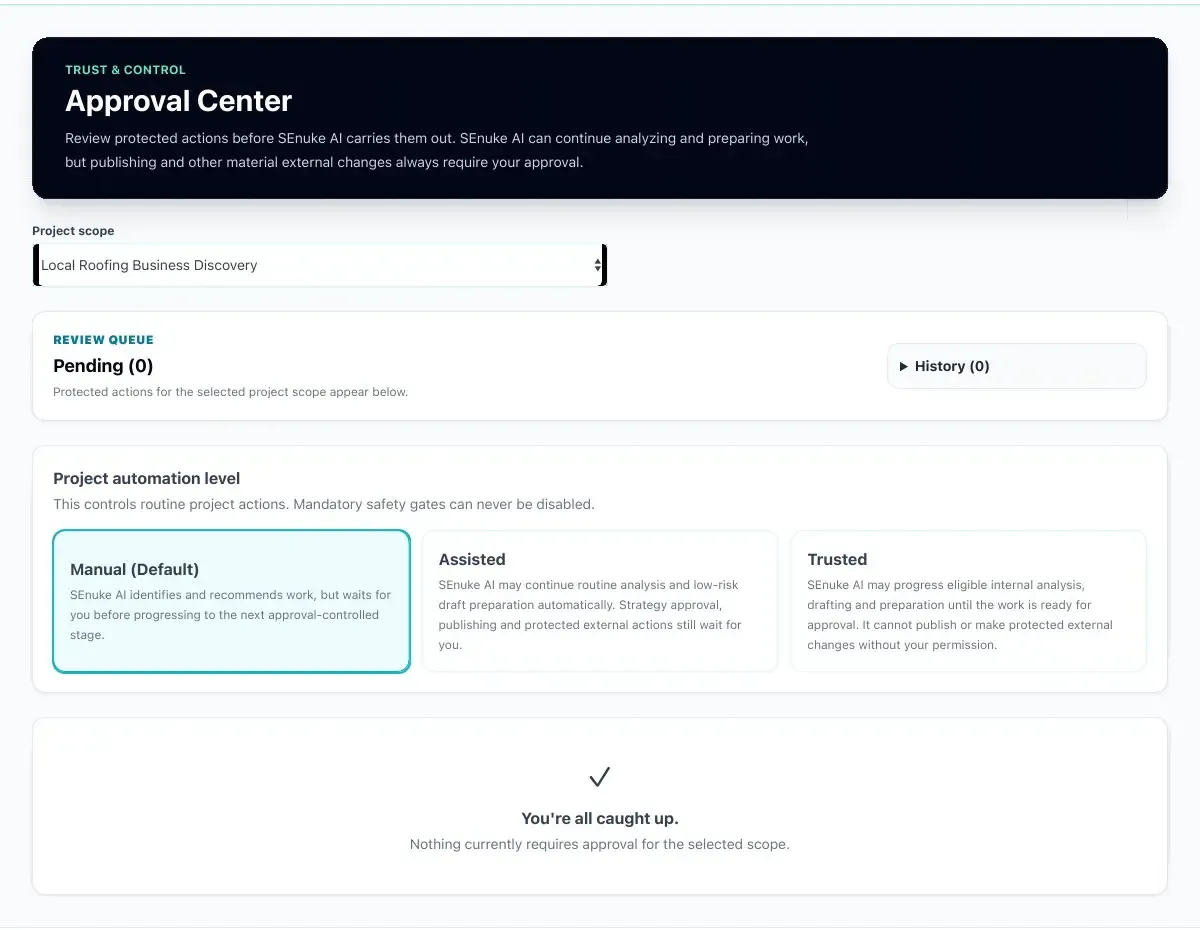
The most useful framing I have seen for this comes from SEnuke AI's Approval Center, which ships with three automation levels. I am quoting the vendor's own descriptions because the wording is precise:
Two details from the official screenshots: Manual is the default, and the Approval Center states that "mandatory safety gates can never be disabled". What makes this a model rather than a feature is that even "Trusted" is scoped: publishing, outreach and external changes still respect approvals, roles and permissions. There is no fourth level called "autonomous". The vendor's partner FAQ answers "Does SEnuke AI execute without approval?" with "No."
You can apply the same three levels to any agent stack, including a self-hosted one. The rule is simple: every task type starts at Manual and earns its way up. An agent moves to Assisted for a task once you have reviewed enough of its output on that task to know its failure modes. It moves to Trusted only when the failure mode is cheap to reverse and you have monitoring that would catch it.
Which tasks belong at which level
Here is how I would sort the common marketing tasks, based on two questions: how public is the failure, and how reversible is it.
| Task | Failure is… | Start at | Can reach |
|---|---|---|---|
| Keyword and competitor research | Private, reversible | Assisted | Trusted |
| Drafting article briefs and outlines | Private, reversible | Assisted | Trusted |
| Weekly performance reports | Private, reversible | Assisted | Trusted |
| Publishing blog content | Public, reversible | Manual | Assisted |
| Social posts | Public, semi-reversible | Manual | Assisted |
| Email broadcasts to your list | Public, irreversible | Manual | Manual |
| Outreach to other people | Public, irreversible | Manual | Manual |
| Changing live site pages | Public, reversible with backups | Manual | Assisted |
| Spending ad budget | Financial, irreversible | Manual | Assisted with hard caps |
| Client-facing reports and proposals | Reputational, irreversible | Manual | Assisted |
Notice that the tasks worth automating first are the private ones — research, drafting, reporting — which also happen to be where the hours go. HubSpot's 2026 report found roughly a third of marketers save 10–14 hours a week with AI and another third save 15 or more. Almost all of that is Assisted-level work. You do not need Trusted to get the time back; you need Assisted with a fast review habit.
Designing the gate so it actually gets used
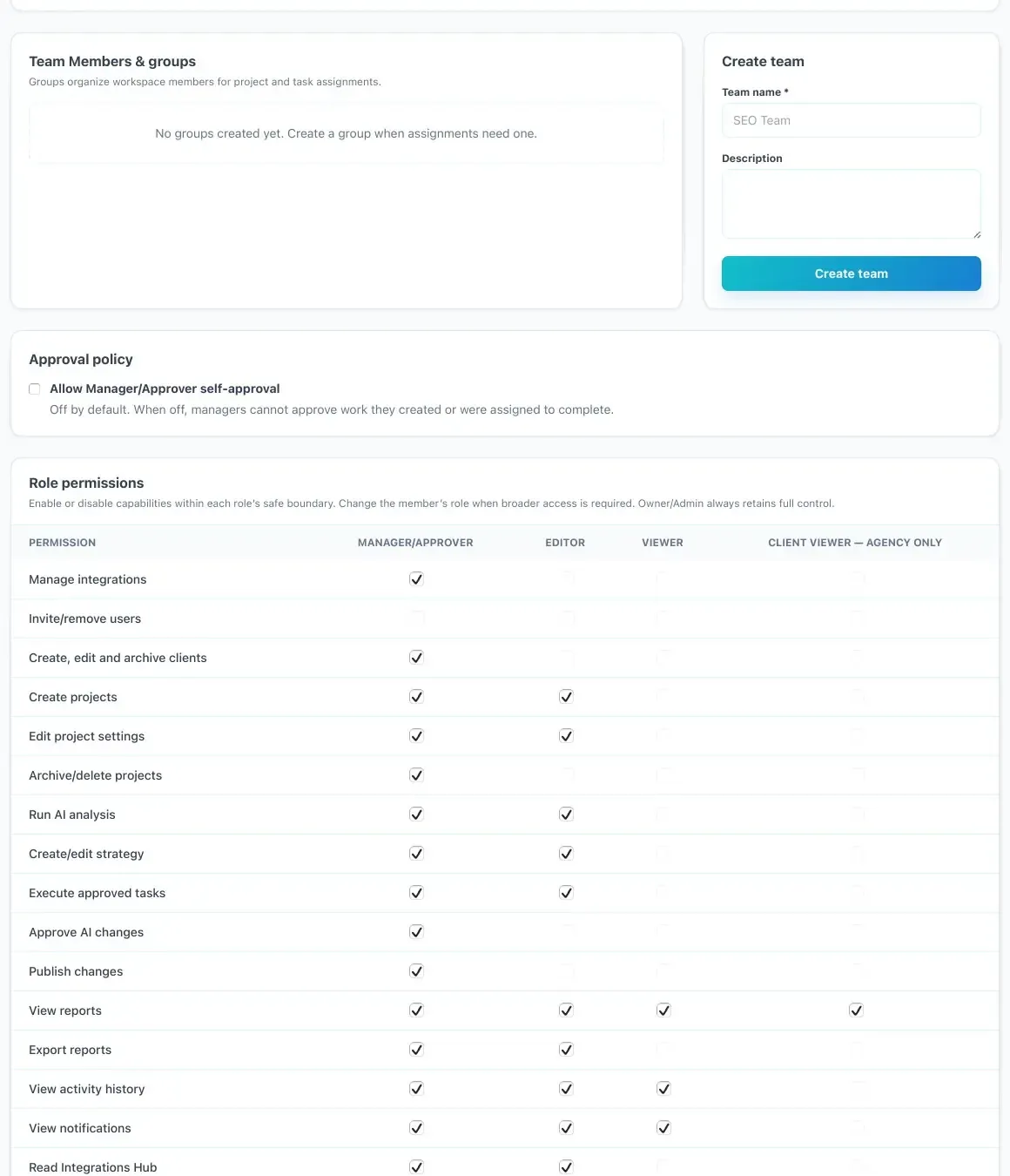
An approval step that people click through is worse than none, because it creates the illusion of control. Four rules from running this myself:
- Approve the reasoning, not just the output. The gate should show why the agent proposes this — which evidence, which goal. If the reasoning is not shown, you are approving on vibes. This is why "Next Best Action with the reasoning attached" is the right shape for a recommendation.
- Batch approvals by type, not by time. Reviewing twelve social posts in one sitting keeps you calibrated. Reviewing one every hour trains you to click yes.
- Keep a planned-versus-shipped log. If the agent proposed forty things and you approved thirty-eight, either the agent is excellent or you have stopped reading. Check which.
- Give every level a kill switch you have actually tested. If you cannot pause an agent in under a minute, it is not at Trusted, whatever the setting says.
For the self-hosters: this is what I set up in How to Run an AI Agent 24/7 on a Mini PC, and the approval layer is the part I would never skip. For people who would rather buy the gate than build it, SEnuke AI's Approval Center is the first packaged version I have seen that treats the three levels as first-class — my review covers it in detail, including what is still unverified before launch.
The counter-argument, fairly
The strongest case for full autonomy is speed and cost. HubSpot moved its Breeze Customer Agent to outcome pricing in April 2026 — $0.50 per resolved conversation — because it resolves 65% of conversations without a human, and that economics only works at Trusted-plus. Google's Performance Max and Meta's Advantage+ spend billions autonomously every day. Autonomy clearly works where the task is narrow, the feedback is immediate and the failure is cheap.
That is exactly the point. Customer-service replies and ad bidding have tight loops and measurable outcomes. Marketing strategy does not: the feedback on "was this the right campaign" arrives in weeks, is confounded by everything else, and the failure is your reputation. The narrower the task and the faster the feedback, the more autonomy is safe. Growth decisions are the widest task with the slowest feedback in the business. They should be the last thing you automate, not the first.
Want to see a packaged approval gate?
SEnuke AI ships with Manual, Assisted and Trusted modes built into its growth loop. My independent review covers the Approval Center, all twelve screens, pricing and the unknowns.
Frequently asked questions
What is a human-in-the-loop AI agent?
An agent whose workflow includes a point where a person reviews and approves an action before it takes effect — typically before anything public, external, financial or irreversible happens. The agent does the preparation; the human makes the call.
Why do so many AI agent projects fail?
Gartner attributes cancellations to escalating costs, unclear business value and inadequate risk controls. Benchmarks show leading agents complete only about a third of realistic multi-step business tasks, so projects that grant autonomy before measuring reliability tend to produce visible, expensive errors.
What is approval fatigue?
The tendency of people to approve agent actions without meaningful review once volume rises. It was documented in an August 2026 paper by researchers at Hugging Face and Data & Society, which recommends deliberate friction, better approval design and monitoring.
What are Manual, Assisted and Trusted modes?
A three-level autonomy model used by SEnuke AI's Approval Center. Manual: you control each important step. Assisted: the system prepares work and brings it for approval. Trusted: approved work proceeds within the permissions and safeguards you set. Even Trusted does not mean unsupervised external actions.
Which marketing tasks are safe to automate fully?
Tasks whose failure is private and reversible: research, drafting, internal reporting. Tasks that are public, external, financial or irreversible — email broadcasts, outreach, ad spend, live site changes, client deliverables — should keep a human approval step.
Should a solo marketer bother with an approval gate?
Yes, arguably more than a team should, because there is no second pair of eyes. The gate is cheap: a daily batch review of what the agent proposes. The cost of skipping it is a public mistake with your name on it.