The strategy-execution gap: why most marketing plans die before they ship — and a 90-day fix
Most marketing plans do not fail because they were wrong. They fail because they were never executed: Bridges Business Consultancy's long-running research puts strategy implementation failure at 67%, Harvard Business Review found only 55% of middle managers can name even one of their company's top five priorities, and CoSchedule found that marketers with a documented strategy are 414% more likely to report success — while only 17% document theirs.
The gap between deciding and doing is the most expensive thing in marketing, and it is worse for solo operators and small teams, because there is no one to notice when the plan quietly dies on a Thursday. This article explains why plans die, the single metric that exposes it, a 90-day cadence that closes the gap without a project manager, and why the "Next Best Action" model in AI growth platforms is a response to exactly this problem.
The size of the gap
The HBR study has one more finding that explains the rest. Nearly 90% of managers believed leaders communicated strategy often enough, and 84% could rely on their own boss and direct reports — but only 9% could rely on colleagues in other units all the time. Strategy does not fail at the top or in the team. It fails in the hand-offs. A solo operator has the same hand-offs, between Monday-you who plans and Thursday-you who has an inbox.
Five ways a marketing plan dies
Having watched a lot of plans die, including my own, the causes are boringly consistent.
1. It was a list, not a strategy
"Post three times a week, publish two articles, run a webinar" is a to-do list. A strategy says which of those matters most and why, so that when time runs out — and it always does — you know what to drop. A plan with no priority order dies the first busy week, because everything gets dropped equally.
2. It had no constraint
LocaliQ's 2026 survey found 60% of small businesses spend one to ten hours a week on marketing and 52% have a monthly budget under $1,000. A plan that does not start from those two numbers is fiction. Most plans are written as if the constraint were ambition.
3. Nobody approved it — including you
There is a difference between writing a plan and deciding to do it. The deciding step is where you say no to the other things. Skip it and the plan competes with everything else on equal terms, and loses to whatever is urgent.
4. Planned and shipped were never compared
If you do not write down what you intended and check it against what happened, the plan can fail silently for months. This is the mechanism behind the 67%. It is also the easiest one to fix.
5. The learning evaporated
The campaign ran, something happened, and three months later you cannot say what or why, so the next plan starts from zero. Evidence that is not kept is not evidence.
Notice the shape. Prioritise, constrain, approve, compare, learn. That is a loop. Every AI "growth operating system" being sold in 2026 — SEnuke AI most explicitly — is a software version of those five steps. The steps are not new. What is new is that software can now do the prioritising and the comparing without a strategy team.
The one metric: planned versus shipped
If you track a single execution number, track this. Each week, write down the marketing actions you decided to take. The following week, count how many actually went out. Divide.
A healthy ratio for a solo operator is 70–85%. Below 50% and you are planning fiction — cut the plan, not the effort. Above 95% for several weeks and you are planning too little, or only the easy things. The number is uncomfortable, which is why almost nobody keeps it and why it works: it is the only marketing metric that measures you rather than the market.
AchieveIt's 2025 data makes the same point at organisational scale: 87% of leaders say real-time monitoring improves execution, and the organisations relying on manual data collection were the ones reporting slowdowns. For one person, "real-time monitoring" is a column in a spreadsheet you look at every Monday.
The 90-day cadence
This is the execution system I use. It needs no software beyond a calendar and a sheet, and it maps directly onto how the better growth platforms structure their loops, so if you later buy one you are not starting over.
Three hours to set up, about an hour a week to run. It is not sophisticated. The 67% failure rate is not caused by a lack of sophistication.
Where Next Best Action comes in
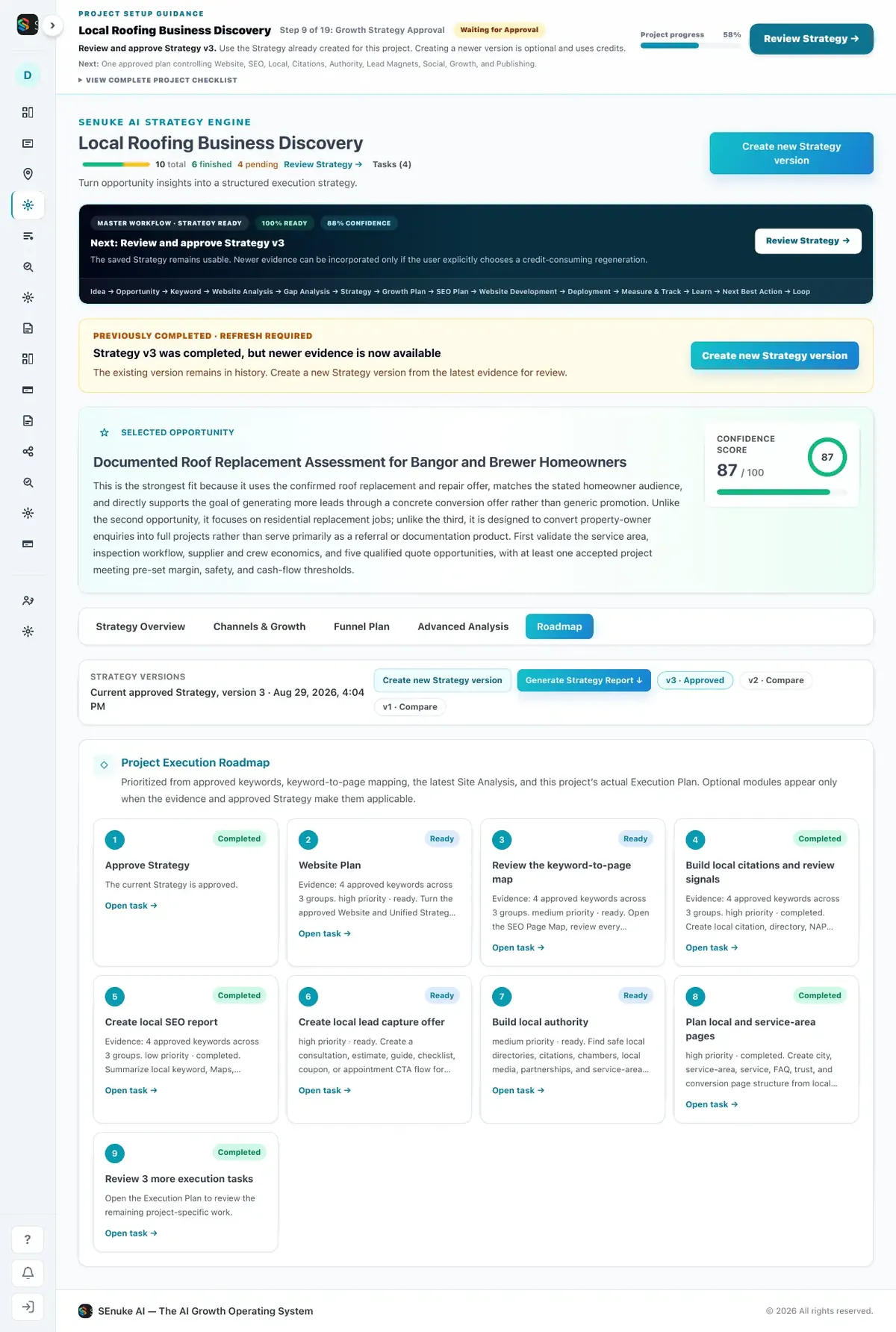
The hardest step in the cadence is number 3: deciding, each week, what the strongest move is given everything you now know. It is the step people skip because it is cognitively expensive and there is no forcing function. It is also the step software is now good at.
"Next Best Action" is a decision-science idea — it descends from the OODA loop and became a marketing term through customer-journey systems that pick the one best offer for each customer. Gartner expects that by 2027, half of business decisions will be augmented or automated by AI agents for decision intelligence. The 2026 growth platforms apply the idea to the business itself: given the goal, the constraint, the evidence and the results so far, what is the single strongest thing to do next, and why?
SEnuke AI's version — the reason it is worth mentioning here — attaches the reasoning to the recommendation, and puts an approval gate after it. That is step 3 of the cadence, packaged: the system proposes, you decide, and the decision is logged. Whether the proposals are good is what nobody outside the company can say before 8 September, and my review is explicit about that. But the shape is right, and the shape is what most plans are missing.
A warning that applies to every tool in this category: a Next Best Action engine will not fix a low planned-versus-shipped ratio. If you do not act on your own decisions, you will not act on the software's. Run the cadence by hand for a month first. If your ratio is above 60%, a decision layer will make you faster. If it is below, the software will just produce a more sophisticated list of things you do not do.
For teams and agencies: the hand-off problem
HBR's finding that only 9% of managers can rely on colleagues in other units is the agency problem in one number. Strategy lives with the account lead, execution with the content person, measurement with whoever has the analytics login, and the client sees none of it until the monthly report. The fix is the same cadence with two additions: the ranked initiative list is visible to everyone, and the approval step is a named person, not a meeting. Growth platforms that offer client-facing approval and white-label reporting — SEnuke AI's Agency plan does both — are essentially selling that visibility. You can also build it with a shared sheet and discipline; the platform is buying the discipline.
Want the loop run for you?
SEnuke AI packages exactly this cycle — prioritised blueprint, approval gate, execution queue, versioned monthly reports and a Next Best Action with reasoning. My review covers what is proven, what is not, and what a year really costs.
Frequently asked questions
What is the strategy-execution gap?
The distance between what an organisation decides to do and what actually gets done. Research from Bridges Business Consultancy puts implementation failure at around 67%; HBR's study of 8,000 managers found only 55% could name one of their company's top five priorities.
Why do marketing plans fail?
Most commonly because they were lists rather than prioritised strategies, ignored the real time and budget constraint, were never explicitly approved, were never compared against what shipped, and produced no retained learning. Almost all of these are process failures, not idea failures.
What is planned versus shipped?
A weekly ratio: the number of marketing actions you actually completed divided by the number you decided to do. A healthy range for a solo operator is 70–85%. It is the only marketing metric that measures your execution rather than the market.
How do I create a 90-day marketing plan that actually gets executed?
One goal, one constraint, one strategy paragraph, three ranked initiatives, a 20-minute Monday decision, a weekly shipped log, a 45-minute monthly review and a day-90 re-rank. About an hour a week to run.
What is Next Best Action in marketing?
The single strongest evidence-based move to make next, given goals, constraints and results so far. It originated in customer-journey decisioning and is now applied to whole-business growth by platforms like SEnuke AI, which attaches the reasoning and requires approval before execution.
Can software fix the strategy-execution gap?
Partly. Software is now good at the prioritising and comparing steps most people skip. It cannot make you act on a decision — if your planned-versus-shipped ratio is low, a recommendation engine produces a better list of things you still do not do. Run the cadence by hand first.