Business intelligence for solo operators: data-driven marketing decisions without a data team
Business intelligence has never been cheaper — Power BI is $14 a month, Tableau starts at $15 — and it has never been less used: Gartner puts analytics and BI adoption at about 29% of employees, essentially flat for seven years. The reason is not the software. It is that most businesses, and almost every solo operator, have no written model of the business for the data to attach to. A dashboard without a model is a wall of numbers nobody acts on.
This guide is the fix for a one-person or small-team marketing operation: a one-page "Business Brain" dossier you fill in once and keep current, the five numbers worth tracking weekly, a decision rhythm that takes an hour a week, and where AI growth platforms like SEnuke AI fit — because they need exactly this dossier as input and will give you generic advice without it.
Why the data never turns into decisions
Every solo operator has Google Analytics, a Search Console, an email platform dashboard and a payment processor. That is four BI systems. The problem is not access. Consider the evidence:
The pattern in those numbers: data exists, decisions still run on instinct, and the businesses that do connect the two report better execution. What sits between "data exists" and "decision made" is a model — a written, current statement of what the business is, who it serves, what it is trying to achieve, and what has already been tried. Without that, a number has no meaning. "Traffic is up 12%" is only good news if you know which traffic you wanted.
The one-sentence version: business intelligence for a solo operator is not a dashboard. It is a one-page document plus five numbers plus a weekly hour. Everything below is those three things.
Part one: the Business Brain dossier
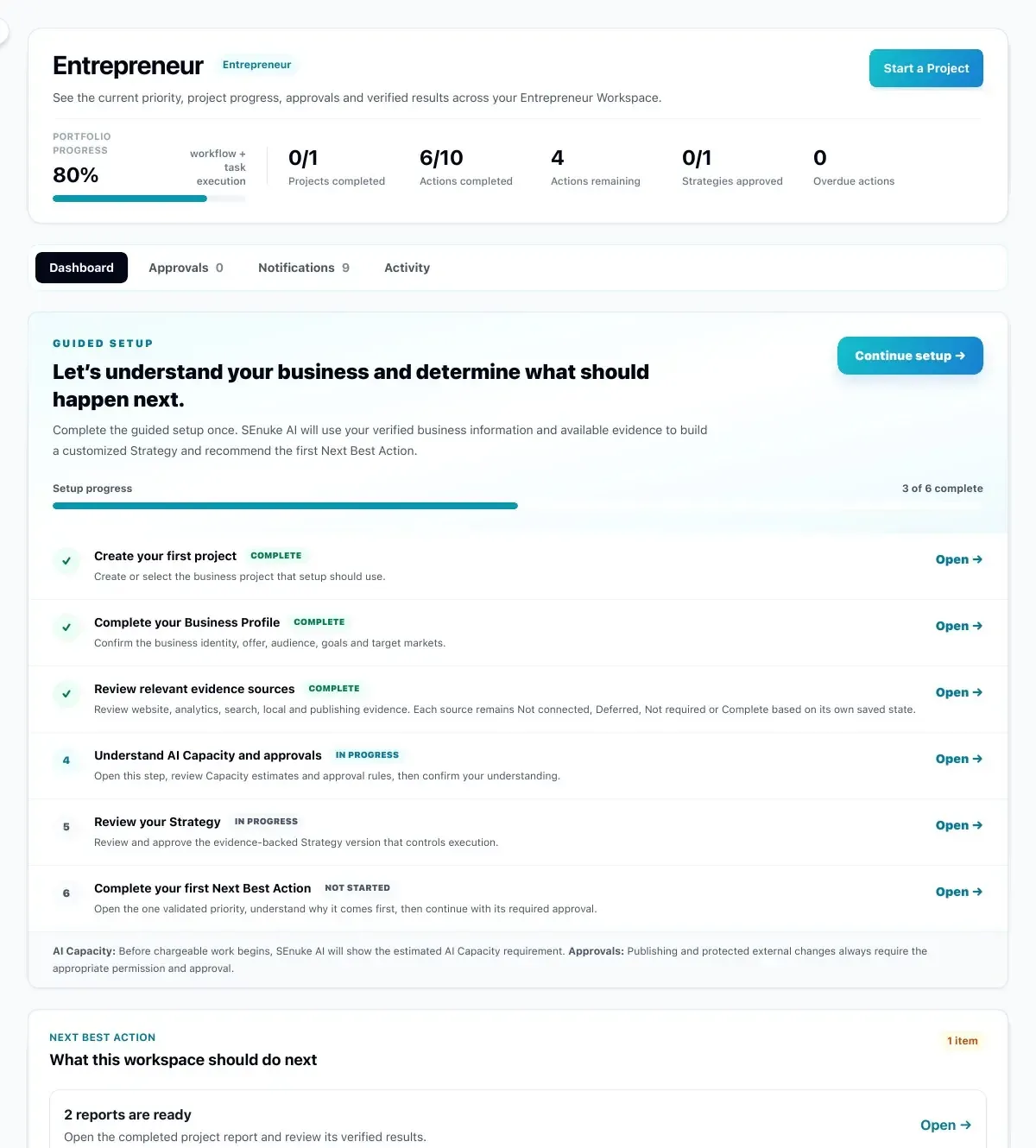
SEnuke AI calls the stored model of your business the "Business Brain", and it is the first thing the platform asks you to build, because every recommendation downstream inherits its quality. You do not need their software to build one. You need a page. Here is the template I use; fill in every line in a sentence or two, and date it.
| Section | What goes here | Why a growth system needs it |
|---|---|---|
| 1. What we are | One paragraph: what you sell, to whom, at what price, through which channel. No adjectives. | Every AI recommendation is generic until this is specific. |
| 2. Best customer | The customer you would clone: who they are, where they were before they found you, what they said when they bought, what they do after. | Targeting, messaging and channel choice all derive from this one profile. |
| 3. Offers | Every product with price, margin, and its job (lead, core, upsell, retention). Which one is the front door. | Prioritisation is impossible without knowing what a sale is worth. |
| 4. Goals, dated | One revenue number for 90 days, one leading indicator (leads, trials, list growth), and the constraint (hours per week, budget). | Without a constraint, every recommendation is "do more". |
| 5. Evidence | What has worked, what has not, with numbers. Last three campaigns, best-performing page, best email, worst money spent. | This is what turns a recommendation engine from a content generator into a decision system. |
| 6. Competitors and alternatives | Three named competitors and what the customer does instead of buying from anyone (the real alternative is usually "nothing"). | Positioning and opportunity discovery start here. |
| 7. Assets and channels | List size, traffic by source, social accounts that actually produce anything, tools you pay for. | Execution planning needs to know what already exists. |
| 8. Open questions | The three things you do not know that would change a decision if you did. | These become the experiments. |
Two hours, once. Then fifteen minutes a month to update sections 4, 5 and 8. In my experience this document does more for decision quality than any tool, because it forces the question every dashboard skips: compared to what?
If you buy SEnuke AI through my link, the Business Brain Dossier bonus is a filled-out, structured version of exactly this dossier, built to be pasted into the platform's setup on day one.
Part two: the five numbers
A solo operator cannot watch forty metrics and should not try. Five, weekly, in a single row of a spreadsheet, is enough to run a business. Pick them from your dossier's goal line.
- Qualified visitors — not total sessions. Visitors to the pages that lead to money (offer pages, opt-in pages, key articles). Source: analytics, filtered to those URLs.
- Leads or list growth — net new subscribers or trials this week. Source: your email platform.
- Conversion rate at the front door — leads divided by qualified visitors. This is the number most likely to move with small effort.
- Revenue, and from which offer — the weekly number and its split. Source: your payment processor.
- Planned versus shipped — how many of the things you decided to do last week actually went out. This is the most honest number in marketing and almost nobody tracks it.
The fifth number is the one a growth loop is built around. The Harvard Business Review study of strategy execution found only 55% of middle managers could name one of their company's top five priorities; a solo operator has the same disease with a smaller body — the plan lives in your head, and by Thursday it has been replaced by whatever arrived in the inbox. Writing down what you planned and checking what shipped is the entire discipline.
Part three: the weekly hour
Business intelligence is a rhythm, not a report. This is the one that works for one person:
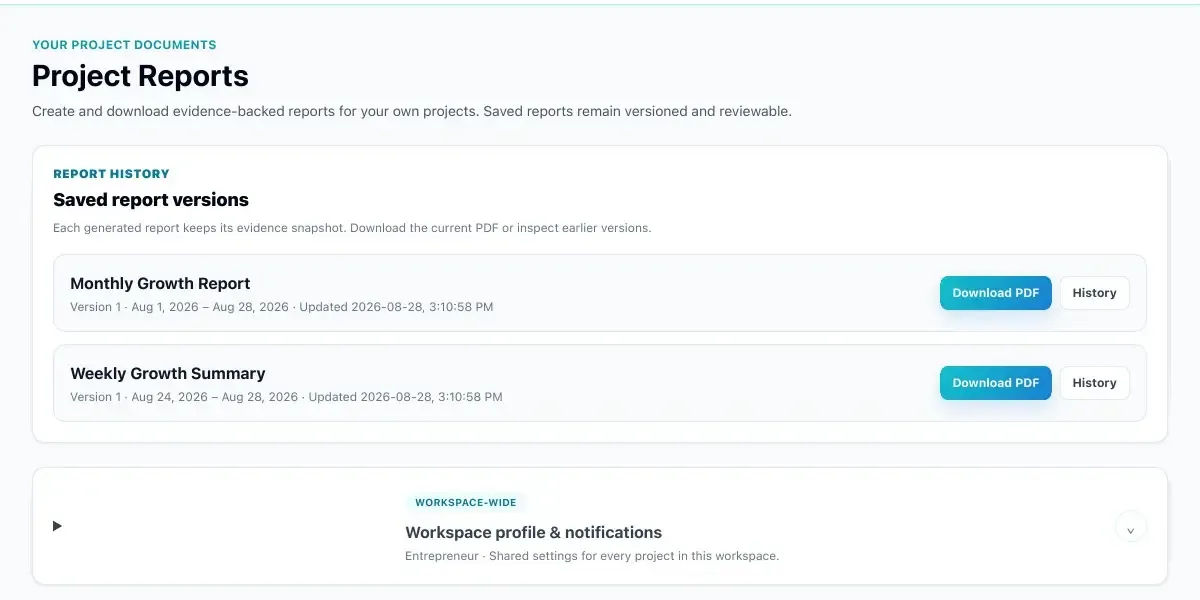
That is the whole loop: understand (dossier), measure (five numbers), decide (one action), execute (calendar), learn (next week's comparison). It is the same loop SEnuke AI and every other growth platform sells, run by hand in sixty minutes. Doing it by hand for a month before buying software has two benefits: you will know whether you are the kind of person who acts on a recommendation, and you will have the dossier the software needs.
Where the tools fit
Once the model exists, tools become useful, and the cheap ones are enough.
| Need | Solo-operator option | Cost (Sept 2026) |
|---|---|---|
| Recording the five numbers | A spreadsheet. Seriously. | $0 |
| A shareable dashboard, if you have a partner or client | Power BI Pro, Tableau Standard, Looker Studio | $14 / $15 per user per month / free |
| Search and AI-search visibility data | Search Console (free), then Semrush or Ahrefs when you need depth | $0, then $139 / $129 |
| The decision layer — turning the dossier and numbers into a prioritised next action | Do it by hand (above), or a growth platform that ingests the dossier | Your hour, or from $79 per month for SEnuke AI |
The honest position on the last row: the weekly hour works. What a platform adds is the research you do not have time for (opportunity and keyword intelligence), the memory you do not keep (versioned reports that carry learning forward), and the discipline of an approval queue. Whether that is worth $79 a month depends on whether your hours or your dollars are scarcer. For most people reading this, it is the hours — LocaliQ's 2026 survey found 60% of small businesses give marketing one to ten hours a week.
The mistakes to avoid
- Building the dashboard before the dossier. You will build a beautiful view of numbers you cannot interpret.
- Tracking vanity numbers because they are easy. Followers and impressions are not on the list for a reason.
- Changing the five numbers every month. The value is in the trend. Pick them once per quarter.
- Letting the AI fill in the dossier. An AI can format it; the content has to come from you or it will be plausible and wrong — the same failure Gartner's "agent washing" warning describes for vendors.
- Skipping planned-versus-shipped because it is embarrassing. It is supposed to be. That is the signal.
Want the decision layer done for you?
SEnuke AI is built around a Business Brain that ingests exactly this dossier, then runs the research, prioritisation and reporting inside a loop with an approval gate. My review covers what it does, what it costs and what is still unproven before launch.
Frequently asked questions
What is business intelligence for a small business?
The practice of turning the data you already have — analytics, email, payments, search — into decisions. For a solo operator it needs three things: a written model of the business, a handful of tracked numbers, and a weekly rhythm to compare them. Software is optional.
Do I need a BI tool like Power BI or Tableau?
Only if you need to share a view with a partner or client. Both are cheap (Power BI Pro $14 per user per month, Tableau from $15), but a spreadsheet with five weekly numbers does the job for one person.
What is a Business Brain?
SEnuke AI's term for the stored model of a business — what it is, who it serves, its offers, goals, evidence, competitors and assets — that the platform uses to make every recommendation specific. You can build the same thing as a one-page dossier without any software.
What are the most important marketing metrics for a solo operator?
Qualified visitors, leads or list growth, front-door conversion rate, revenue by offer, and planned-versus-shipped. Five numbers, weekly, in one row.
How much time should a solo operator spend on marketing analytics?
About an hour a week: ten minutes recording, fifteen comparing to your goals, twenty deciding one next action, fifteen scheduling it. More than that is usually procrastination dressed as analysis.
How does an AI growth platform use business intelligence?
It ingests your business model and evidence, adds its own research (market, keyword, competitor, AI-search data), produces a prioritised next action with reasoning, and — after you approve — measures the result and feeds it back. The quality of its output is capped by the quality of the model you give it.