What happened to SEnuke? The full history from 2008 backlink automation to SEnuke AI in 2026
SEnuke was one of the best-known SEO tools of its era: desktop software, launched in June 2008 by Joe Russell and Areeb Bajwa, that automated backlink creation across dozens of Web 2.0 and social sites. Google's Penguin update in April 2012 broke the approach it was built on. The product did not die then — it was relaunched as SEnuke XCr in 2012 and SEnuke TNG in 2016 and 2018 — but it faded out through 2020–21, and Russell eventually listed senuke.com for sale.
In July 2026 he announced SEnuke AI, a cloud platform that shares the name and nothing else: it does not build backlinks, it decides what a business should do next and asks for approval before doing it. Here is the whole timeline with sources, because the shorthand version you will find on most affiliate pages — "discontinued after Penguin" — is wrong, and the real story matters more for judging a subscription than the myth does.
The timeline
What the original SEnuke actually did
For readers who arrived after 2012: the original product automated the thing Google spent the next decade trying to stop. You wrote (or spun) an article, SEnuke created accounts on dozens of free web properties, published variations of the article with links back to your site, built links to those links, and pinged everything so it got indexed. In 2008–2011 this worked astonishingly well, because Google's ranking model counted links and did not yet discount where they came from. I used it. It ranked things.
Penguin changed the model: links from automated, low-quality properties went from neutral to negative. The tool did not stop producing links; the links stopped being worth having. Every version after 2012 — XCr, TNG — was an attempt to keep the same mechanism useful in a world that had moved on, with more "safe" settings and more filtering. The community's verdict, visible in every thread from 2013 on, is that it worked less each year and was increasingly buggy. SEO writers in 2026 still use SEnuke X as the poster child for "why automated link building died."
If you are considering SEnuke AI because you hope it is the 2011 product with an AI wrapper, stop. It is not, the vendor says so explicitly, and you should be glad: that product would be a liability today. If you are avoiding SEnuke AI because you assume it is that product, the same applies in reverse.
What is actually different in 2026
The vendor's own framing of the change, from the Founder Journal (30 July 2026): "I stopped thinking about what AI could create and started thinking about what AI could understand." Concretely, the new platform:
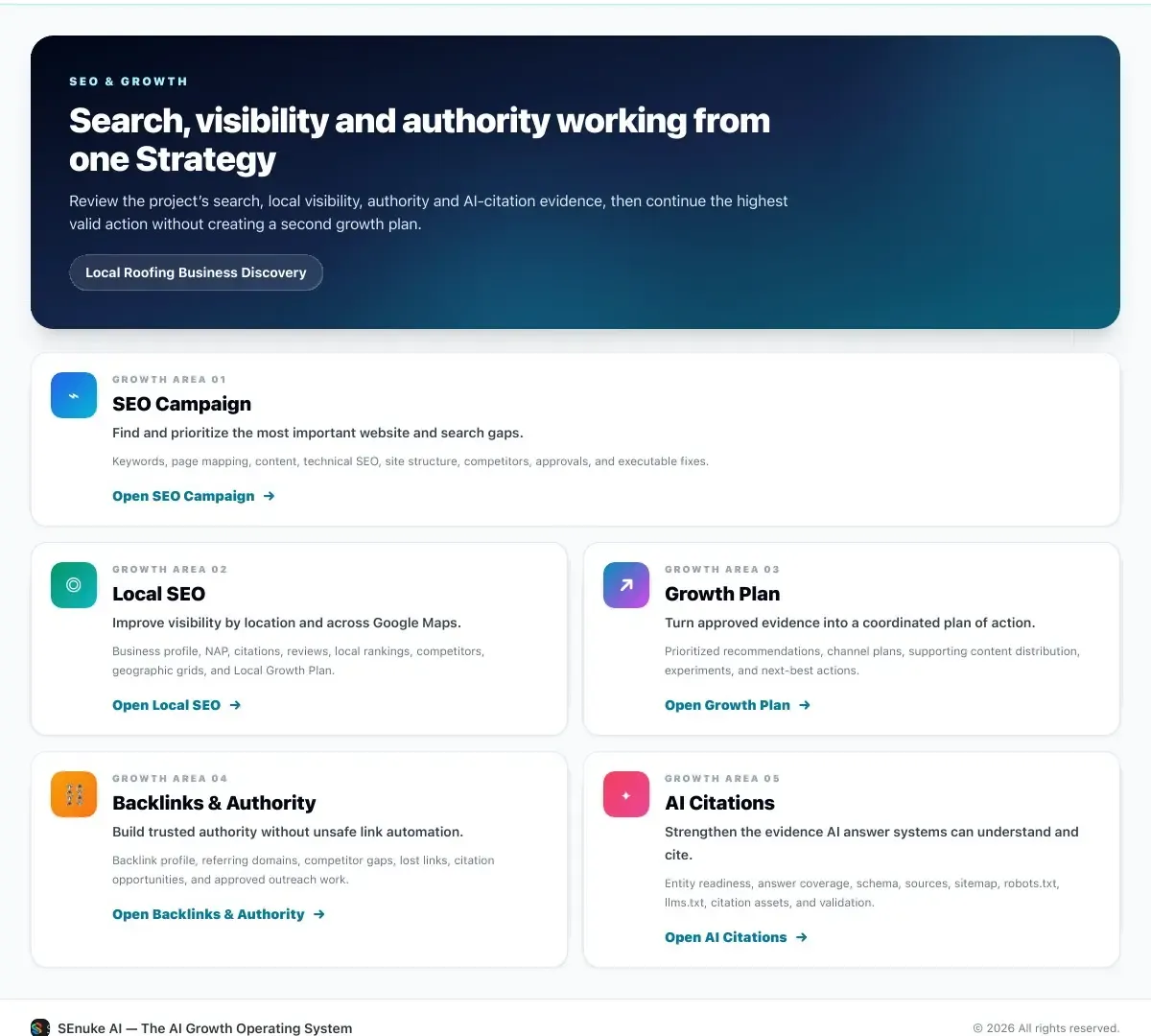
- Does not build backlinks automatically and does not claim to. Link and authority work appears as opportunity discovery — where a link would be worth earning — not as automated creation. The partner FAQ states this directly.
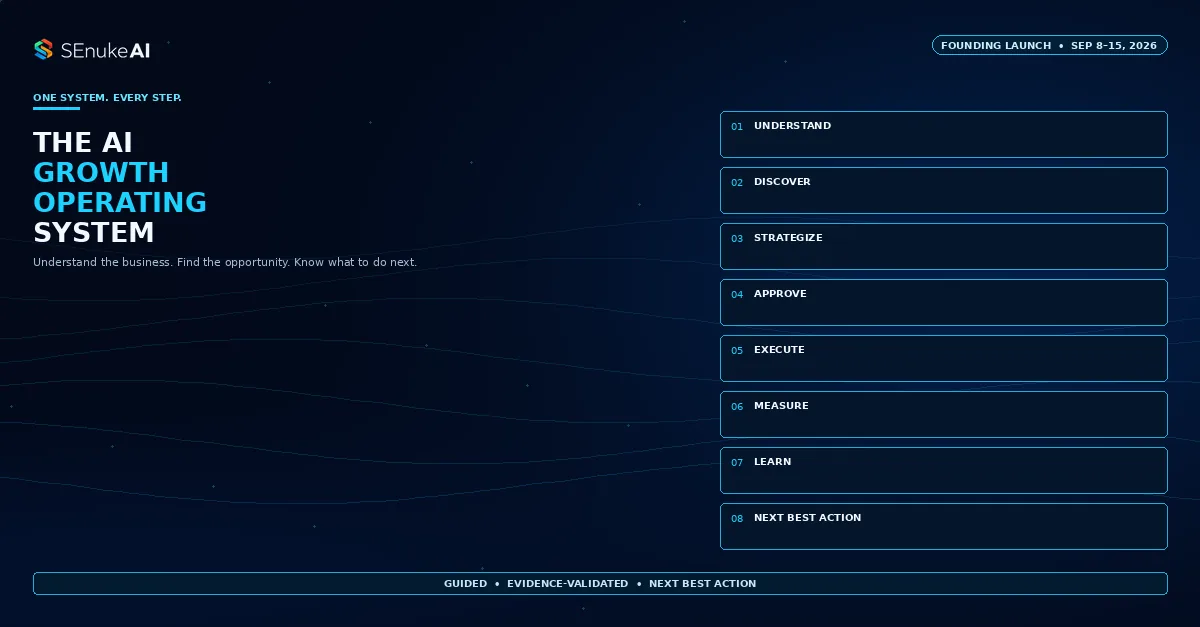
- Runs a loop, not a campaign: understand the business, discover opportunities, strategise, approve, execute, measure, learn, next action. The old product had one step: execute.
- Has a human approval gate with three settings (Manual, Assisted, Trusted). The old product's selling point was that nothing needed approval.
- Is cloud, subscription-only. No lifetime licence — which, given what happened to the 2013 lifetime buyers, is arguably the honest model.
- Forbids its own affiliates from claiming guaranteed rankings, "uncontrolled autonomous changes" or unsupported integrations, per the partner page's claim rules.
Whether the new platform is good is a separate question, and nobody outside the company can answer it before 8 September. But it is not the old one.
What the history means for judging the new product
Two readings, both fair.
The case for: Joe Russell has shipped and sold software in the same market since 2008 — 2008, 2011, 2012, 2016, 2018 — and his JVZoo profile shows a verified seller since July 2013 with 7,000+ sales. Very few vendors from the 2008 cohort still exist. The new product's design is the opposite of the old one's risk profile. And it is a monthly subscription with JVZoo as retailer, which caps your downside at one month.
The case against: the last product's final years were marked by bugs, unresponsive support and a lifetime-licence decision that left early buyers behind. The new site's privacy page names no legal entity. The launch date has already moved once. The walkthrough video was still a placeholder on 4 September. Those are the symptoms of a small team stretched thin, and they were the symptoms in 2020 too.
How I weigh it: the complaints cluster at the end of a product's life, when a desktop tool was being kept alive past its era. A fresh cloud build with a fresh business model does not erase that, but it changes what it predicts. My practical conclusion is in the pricing guide: monthly first, annual only after a month of use, and treat the founding-price lock as the reason to decide during the window rather than the reason to pay for a year up front.
Sources
- IM NewsWatch, 10 June 2008 — launch report
- PR.com, 14 March 2011 — SEnuke X press release
- BlackHatWorld, April 2012 — "SEnuke X still work?"
- SEnuke XCr directory listing — pricing, trial, guarantee, IATC Enterprises
- Warrior Forum, 2013 — results after Penguin 2.1
- PR Newswire, 2014 — IATC Enterprises, Tobique, New Brunswick
- MunchEye — SEnuke TNG launch, April 2016 · BHW — TNG first impressions · BHW — "really disappointed with SEnuke TNG"
- JVZoo — TNG 2018 listing (no longer active) · SEOviser, 2020 — TNG pricing
- BHW, March 2020 — "Is SEnuke TNG going out of business?" · BHW, September 2021 — lifetime licence exclusion
- SEnuke AI Founder Journal, July–August 2026 · Partner Headquarters · JVZoo listing, SEnuke AI · Earlier prelaunch page with the 31 August date
Now read what the new platform actually is
All twelve screens, the Manual/Assisted/Trusted approval levels, seats, real twelve-month cost, and everything nobody can verify before 8 September.
Frequently asked questions
What was SEnuke?
Desktop SEO software launched in June 2008 by Joe Russell and Areeb Bajwa that automated backlink creation: it published spun content with links across dozens of Web 2.0, video and social sites. It went through versions X (2011), XCr (2012) and TNG (2016–2021).
Was SEnuke discontinued after Google Penguin?
No. Penguin (April 2012) broke the approach, but SEnuke XCr launched in September 2012 and SEnuke TNG in April 2016, with a relaunch in January 2018. The product faded through 2020–21 and its JVZoo listing is now inactive.
Who made SEnuke?
Joe Russell and Areeb Bajwa, through IATC Enterprises in New Brunswick, Canada. Russell is the founder of SEnuke AI; Bajwa's involvement in the new product is not mentioned anywhere on the current site.
Does SEnuke still work?
The original software is effectively retired: the TNG JVZoo listing is no longer active and community reports from 2020–21 describe stalled updates. Automated link building of that kind has been penalised by Google since 2012.
Is SEnuke AI the same as SEnuke?
No. SEnuke AI, launching 8 September 2026, is a cloud subscription that builds a model of your business, prioritises opportunities, requires approval and executes approved work. It does not build backlinks automatically and does not claim to.
Why did Joe Russell bring SEnuke back?
His stated reason, from the Founder Journal: AI changed what he believed software could do — 'I stopped thinking about what AI could create and started thinking about what AI could understand.' He had previously listed the domain for sale.
How much did the original SEnuke cost?
SEnuke XCr was $67 or $147 a month in 2012 with a 14-day trial; lifetime licences resold for around $1,450–$1,497. SEnuke TNG was $67–$147 front end in 2016, $77 a month after a $1 trial in 2018, and $97 a month, $777 a year or $1,377 lifetime by 2020.