What is an AI Growth Operating System — and how is it different from an AI agent, a CRM or an SEO tool?
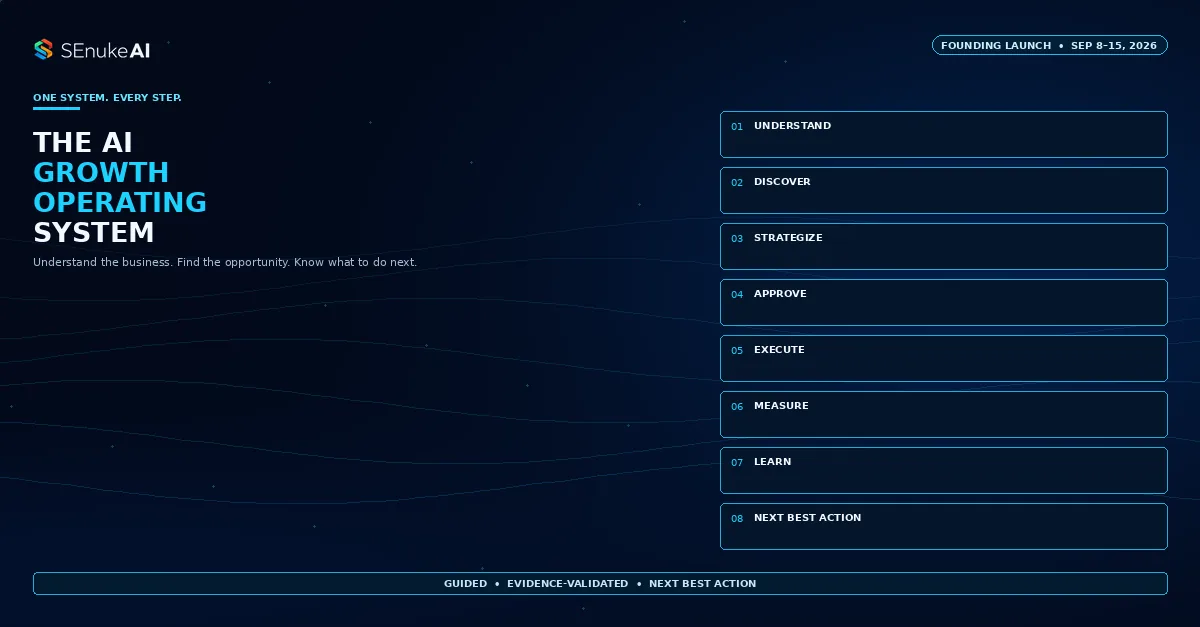
An AI Growth Operating System is software that understands your business first, decides what should be done next, gets your approval, executes the approved work, measures the result and feeds that result back into the next decision. The defining feature is not any one capability. It is that the capabilities run as a loop rather than as separate tools you have to connect in your head.
The term was coined by SEnuke AI, which launches on 8 September 2026 and calls itself "the first AI Growth Operating System". That makes it a vendor category, the way "CRM" and "marketing automation" once were. The idea underneath it is older and sound: a chatbot answers, a tool generates, an agent performs a task, and none of them decides whether the task was worth doing. This article explains the category, gives you a ten-question test to run on any platform, and maps the 2026 market against it.
Why a new category exists at all
Here is the problem every marketer with an AI subscription has run into. The tools are extraordinary at producing output. Ask for twenty blog titles, a landing page, a month of social posts, and they arrive in seconds. What none of them tell you is whether any of that should exist. The hardest question in marketing has never been "how do I make this?" It is "what deserves to be made, given everything I know about this business and what has already worked?"
The numbers say this is where the money is leaking. HubSpot's 2026 State of Marketing report found 86% of marketing teams now use AI, and the most common heavy use is content creation (42.5%) — output, not decisions. Meanwhile Gartner's October 2025 survey of 413 martech leaders found 45% of those with AI agents in pilot or production say the vendor-offered agents fail to meet their expectations. And CoSchedule's long-running strategy survey found marketers with a documented strategy are 414% more likely to report success, yet only 17% document theirs fully.
Put those together: everyone has the output tools, almost nobody has the decision layer, and the decision layer is what correlates with results. That is the gap an AI Growth Operating System is trying to fill.
The definition, and the five-step evolution behind it
SEnuke AI's own category page defines it like this: "an intelligent business-growth system that understands the business, identifies and prioritizes opportunities, develops strategy, helps execute approved work, measures outcomes, learns from the results and continuously determines what should happen next." It then draws a progression that is useful regardless of whether you ever buy their product:
The line that matters is between 4 and 5. Levels 1 to 4 all start from a command you give. Level 5 starts from an understanding of the business and produces the command itself, then asks you whether to run it. Their phrasing: "Executing the wrong thing faster isn't a growth strategy."
The honest caveat: this is a framework published by a vendor to define a category it wants to own. That does not make it wrong — Salesforce did the same with "CRM" and HubSpot with "inbound". It does mean you should test the claim rather than accept the label, which is what the next section is for.
The operating model: Know, Decide, Do, Learn
Strip away the branding and a growth OS has four jobs, arranged as a loop.
- Know — maintain a living model of the business: who it serves, what it sells, what it is trying to achieve, what evidence exists. SEnuke AI calls this the Business Brain. Without this layer, every recommendation is generic.
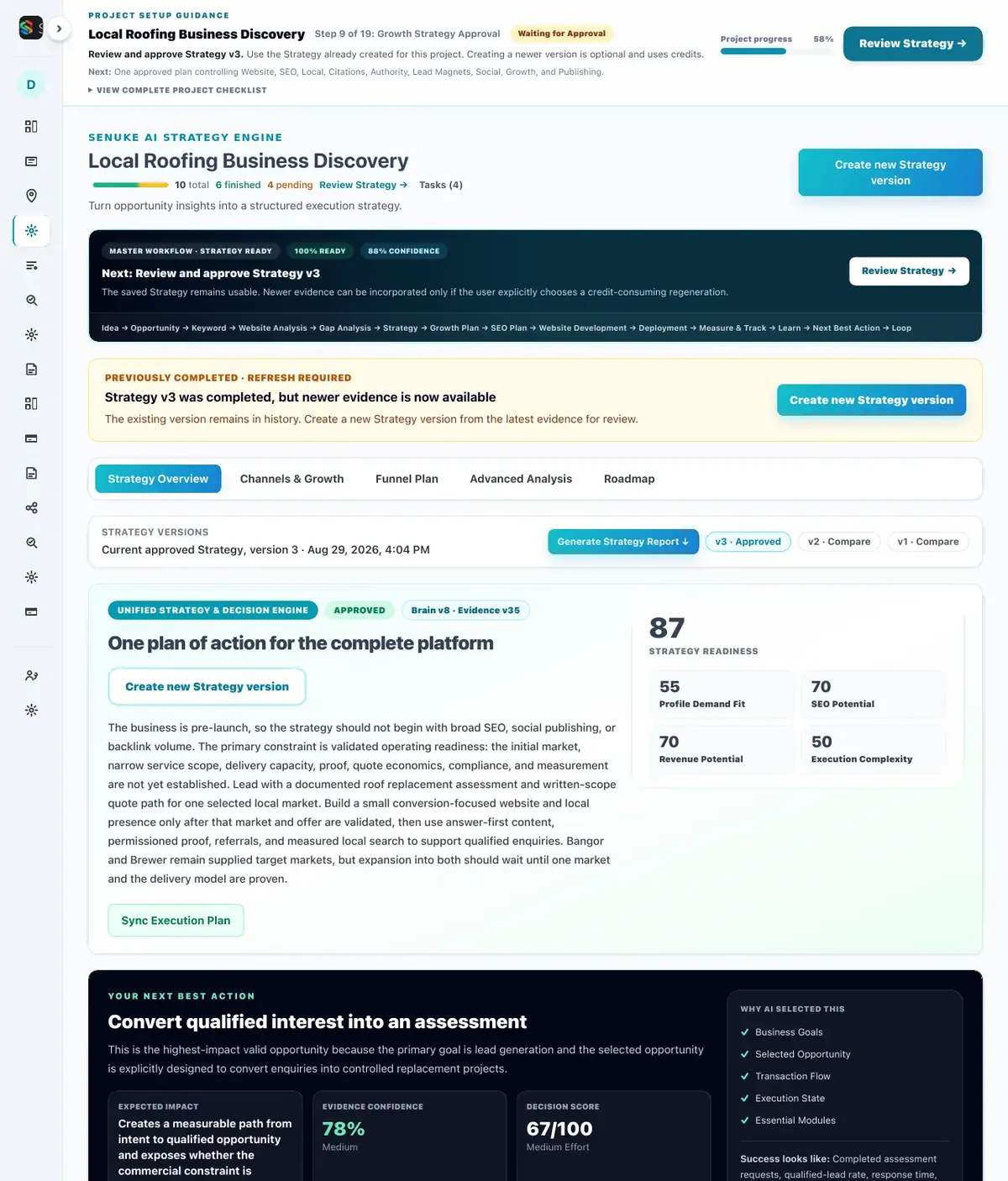
- Decide — find opportunities, weigh evidence, build a prioritised strategy, and surface the single strongest next action. This is the layer point tools do not have.
- Do — turn approved strategy into coordinated work, with a human gate before anything external happens. In SEnuke AI's case that gate has three settings: Manual, Assisted and Trusted.
- Learn — measure outcomes against business goals rather than activity, keep the learning, and feed it back into Know.
If that shape looks familiar, it should. It is John Boyd's OODA loop (observe, orient, decide, act) and Deming's plan-do-check-act, with software doing the observing and orienting. The novelty is not the loop. It is that an LLM can now do the "orient" step — reading a business and a market and producing a defensible priority — well enough to be worth paying for. Whether a specific product does it well is a product question, not a category question.
The ten-question test you can run on any tool
SEnuke AI publishes a "Growth Operating System Test" on its category page. It is written so their product passes, obviously. It is still the most useful checklist I have seen for cutting through 2026 AI marketing copy, so here it is with a note on what a real "yes" looks like for each.
| # | Does it… | What a real "yes" looks like |
|---|---|---|
| 1 | Understand the business? | It stores a model of your business and uses it in every output without you re-explaining. A chat history is not a model. |
| 2 | Discover opportunities? | It surfaces options you did not ask about, from market, competitor or funnel data. |
| 3 | Connect intelligence? | The SEO module knows what the funnel module found. Separate dashboards are a "no". |
| 4 | Prioritise actions? | It ranks. A list of fifteen "recommendations" of equal weight is a "no". |
| 5 | Develop strategy? | Positioning, offers, channels and sequence — not a content calendar. |
| 6 | Coordinate execution? | Approved work moves through a queue with ownership and order, and nothing external ships without approval. |
| 7 | Measure outcomes? | Leads, conversions, revenue. Impressions and followers alone are a "no". |
| 8 | Learn from results? | Last month's result visibly changes this month's recommendation. |
| 9 | Adjust future strategy? | The strategy document is versioned and changes, not a one-time PDF. |
| 10 | Determine the next best action? | One recommended move, with the reasoning and evidence attached. |
Run this on whatever you currently pay for. In my experience most stacks score two or three, usually on questions 2 and 7, and the reason growth feels like guesswork is questions 1, 4 and 8.
AI marketing platform vs growth OS: where the 2026 market sits
This category is new enough that G2 only created an "AI Marketing Agents" category in May 2026. Here is how the tools people actually use map onto the levels above, with pricing from each vendor's page on 4 September 2026.
| Tool | Level | From | What it is |
|---|---|---|---|
| Semrush / Ahrefs | Data + AI tool | $139 / $129 per month | The deepest research indexes in the industry. AI features exist but sit in separate modules; you do the prioritising. AI visibility is a paid add-on ($99 / $199). |
| Surfer, Writesonic, Jasper | AI tool | $49 / $79 / $69 per month | Best-in-class at one job each: on-page optimisation, AI search tracking, brand-voice content. None decides what to make. |
| HubSpot Breeze agents | AI agent | $0.50 per resolved conversation, $1 per lead, on a Pro/Enterprise hub | Task agents priced per outcome. Powerful inside HubSpot; the strategy is still yours. |
| GoHighLevel | Operator / execution layer | $97 per month | CRM, funnels, automation, white-label. Executes brilliantly. Has no idea what your business should do next. |
| Sintra | Bundled AI assistants | $97 list, frequently discounted | Twelve named "AI helpers" on a credit system. Closer to a team of level-2 tools than to a loop. |
| OpenClaw and self-hosted agents | AI agent / operator | Your hardware and API costs | Full control, full responsibility. You build the loop yourself. See my OpenClaw vs ChatGPT piece. |
| SEnuke AI | Growth OS (claimed) | $79 per month founding, $97 after | The only product currently marketed as the full loop with a built-in approval gate. Launches 8 Sept; unproven until then. Full review. |
Two observations. First, nothing in the first six rows is bad — they are the best tools in the world at their level, and a growth OS would use most of them as execution components. Second, the price of the "decision layer" being sold as a category is $79 a month, which is less than any single research tool in the table. If the decision layer is real, that is cheap. If it is a dashboard around a prompt, it is expensive. The launch will tell.
Do you need one?
A growth OS is aimed at a specific person, and it is worth being honest about whether you are that person.
You probably do if
- You have more ideas than hours and the bottleneck is choosing, not producing
- You cannot say which of last quarter's activities produced revenue
- You run several projects or clients and lose context switching between them
- You spend under ten hours a week on marketing — LocaliQ's 2026 survey puts 60% of small businesses there — and need those hours pointed at the right thing
You probably don't if
- You already have a written strategy, a weekly review and a measurement setup that works — you have built the loop by hand
- Your job is data at scale (keyword research for a thousand pages, backlink audits) — a research index will always beat a decision layer at that
- You will not act on a recommendation once you have one — the approval gate means the software cannot work around you
See the category's first product for yourself
SEnuke AI is the platform that named this category. My review covers all twelve screens, the Manual/Assisted/Trusted approval levels, seats, real twelve-month cost and the parts nobody can verify yet.
Frequently asked questions
What is an AI Growth Operating System?
Software that maintains a model of your business, finds and prioritises opportunities, builds a strategy, executes the work you approve, measures outcomes against business goals and feeds the results back into the next decision. The defining feature is the loop, not any single capability.
Who coined the term AI Growth Operating System?
SEnuke AI, a platform by Joe Russell launching 8 September 2026, which markets itself as the first AI Growth Operating System. It is a vendor-defined category, like CRM or marketing automation were originally.
How is a growth OS different from an AI agent?
An AI agent performs a task you give it, with some autonomy. A growth OS decides which task is worth doing, asks for approval, then uses agents or integrations to execute. Agents are components inside a growth OS, not the same thing.
How is it different from a CRM like HubSpot or GoHighLevel?
A CRM stores contacts and runs automations you design. It is an execution and record-keeping layer. A growth OS sits above that: it decides what campaigns should exist and why, and can push approved work into a CRM to run.
How is it different from Semrush or Ahrefs?
Semrush and Ahrefs are research data platforms with the deepest indexes in the industry. They tell you what is happening; the prioritising and deciding is yours. A growth OS uses that kind of data to make a recommendation and get your approval.
Does an AI Growth Operating System require human approval?
In SEnuke AI's implementation, yes — nothing external moves forward without approval, with three settings (Manual, Assisted, Trusted). The category definition treats approval as a core step, which is the opposite of the fully-autonomous agent trend.
What is a Next Best Action?
The single strongest evidence-based move a business should consider next, given its goals, current intelligence, priorities and the results of previous work. It changes as new evidence arrives. The idea comes from decision science and John Boyd's OODA loop.
Is SEnuke AI the only AI Growth Operating System?
It is the only product marketed with that exact label as of September 2026. HubSpot Breeze, Salesforce Agentforce and self-hosted agent stacks cover parts of the loop; none is sold as the complete understand-decide-approve-execute-measure-learn cycle.