Next best action marketing for small teams: how it works, with a worked example
Next best action marketing is a decision method: instead of running a fixed campaign calendar, you look at everything you currently know about a customer or a business, score the possible moves, and do the one with the highest expected value first. It started around the early 2000s in bank and telecom CRM systems, where McKinsey reports operators lifting revenue by up to 10% with it. For a small team the unit is not one customer among millions but one business with one open slot this week, and the method still works: one decision, one reason, one review date.
Below: where the idea comes from, what changes when you shrink it from a call centre to a solo operator, a worked example with real unit costs, and the honest state of the software version I am running.
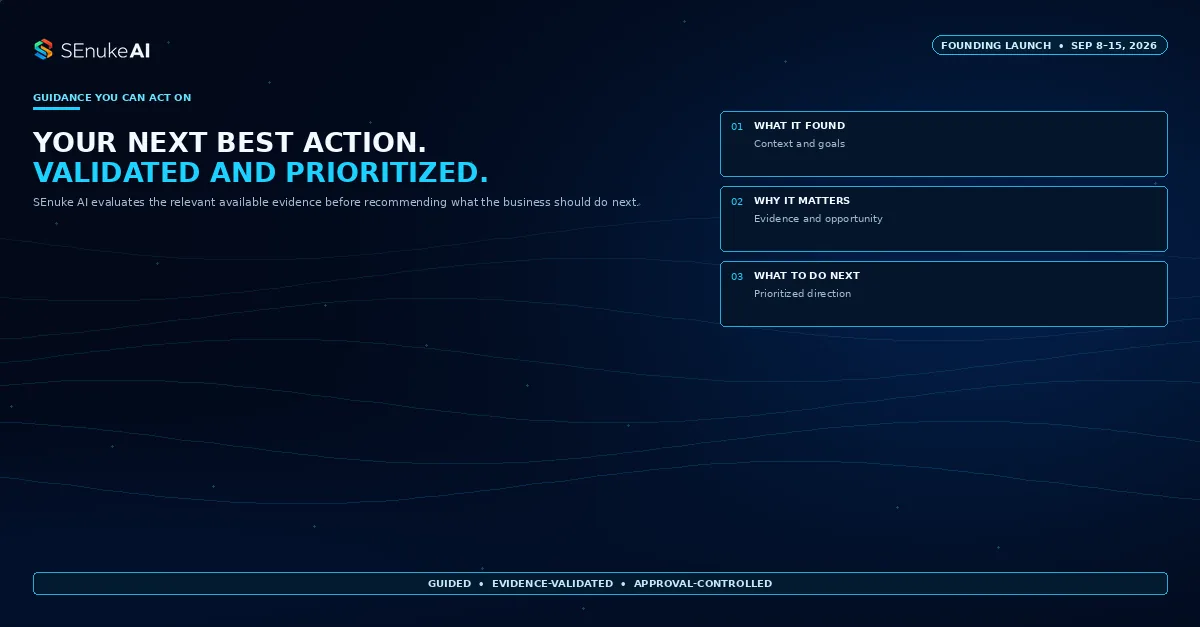
Where next best action comes from
The term was coined in enterprise CRM. Wikipedia's definition is the one most vendors still paraphrase: "a customer-centric marketing approach that considers the different actions that can be taken for a specific customer and decides on the 'best' one." The same entry dates the practical version to "since early this century", when the technology arrived "to allow a company to achieve next-best-action capabilities in high volumes as well as in real-time", and traces the underlying idea to John Boyd's OODA loop (observe, orient, decide, act). Source: Next-best-action marketing, Wikipedia.
The customers were banks and telecoms because they had the three ingredients: millions of accounts, a stream of interaction data, and dozens of possible offers per customer. Pega, the vendor most associated with the term, still leads with the banking case: "When a customer logs into their app, the system analyzes recent transactions and financial behavior to recommend actions such as consolidating debt, opening a savings account, or adjusting spending habits" (pega.com/next-best-action). McKinsey's telecom practice reports that operators running personalisation engines of this kind "can increase revenues up to 10 percent", cites one Eastern European operator that tripled the revenue share from customer value management "from around 2 percent to around 6 percent, within two years" with a next-best-action churn model, and notes that only "around 5 percent" of operators get past pilots (McKinsey, 24 February 2022).
How next best action marketing works, in four steps
Strip away the vendor layer and every next best action system, from a Pega deployment at a bank to a spreadsheet on a solo operator's desk, runs the same four steps.
The one-sentence test: a next best action is a decision you could defend to a sceptical partner in three lines: what we know, why this move beats the alternatives, when we check. If you cannot write those three lines, you have a hunch, not a next best action.
What changes when the team is one to five people
The enterprise version optimises across customers: which offer to show each of a million people. A small team does not have that problem; it has the opposite one. There is one business, one or two people, and more good ideas than hours. The unit of decision shifts from "which offer for this customer" to "which move for this business this week". The table shows what carries over and what does not.
| Element | Bank / telco NBA (2005–2026) | Small-team NBA (what actually fits) |
|---|---|---|
| Decision unit | One customer, one interaction | One business, one week |
| Candidates | Offer catalogue, hundreds of items | Five to ten feasible moves: page, email, offer change, fix, outreach |
| Scoring | Propensity models trained on millions of rows | Expected value × confidence ÷ effort, estimated, written down |
| Evidence | Transaction stream, real time | Analytics, Search Console, reviews, competitor pages, last result; refreshed weekly |
| Who decides | The engine, within business rules | You, from a ranked list; software proposes, you approve |
| Review cadence | Continuous | 7, 14 and 30 days after the action ships |
| Typical failure | Pilots that never scale (McKinsey: only ~5% fully unlock it) | Ranking the list and then doing something else anyway |
The last row is the one that matters. The strategy-execution gap article on this site has the data on how many plans die before they ship; a next best action system for a small team is only worth building if the single ranked move actually gets done. That is why the software versions of it bolt on an execution layer and an approval step, which brings us to the example.
A worked example: one business, one week, real unit costs
Take a two-person business selling an online course to a newsletter list of a few thousand, with a WordPress site and a modest organic footprint. It is a Monday. The evidence on the desk: Search Console shows the top article losing clicks month on month; the last launch email converted at half the previous one; two competitors added a comparison page; the checkout page has no reviews on it. Here is the candidate list scored the small-team way. The scores are illustrative, the method is not.
| Candidate action | Expected value (1–5) | Confidence (1–5) | Effort (1–5, low is easy) | Score (EV × C ÷ E) |
|---|---|---|---|---|
| Add three real reviews and a guarantee block to the checkout page | 4 | 4 | 1 | 16.0 |
| Refresh the declining top article with the comparison the competitors added | 4 | 3 | 2 | 6.0 |
| Re-send the launch email with a new subject line to non-openers | 3 | 3 | 1 | 9.0 |
| Build a new comparison page from scratch | 4 | 2 | 4 | 2.0 |
| Start a paid retargeting test | 3 | 2 | 3 | 2.0 |
The next best action is the checkout fix: highest expected value per hour, and the evidence (no reviews on the page that takes the money) is direct rather than inferred. The three-line defence: we know the checkout has no social proof and the last email converted worse; adding proof to the page every email lands on beats sending more emails to the same page; check conversion on 2 October and 16 October. The email re-send is second and can follow the same week if the first ships in a morning.
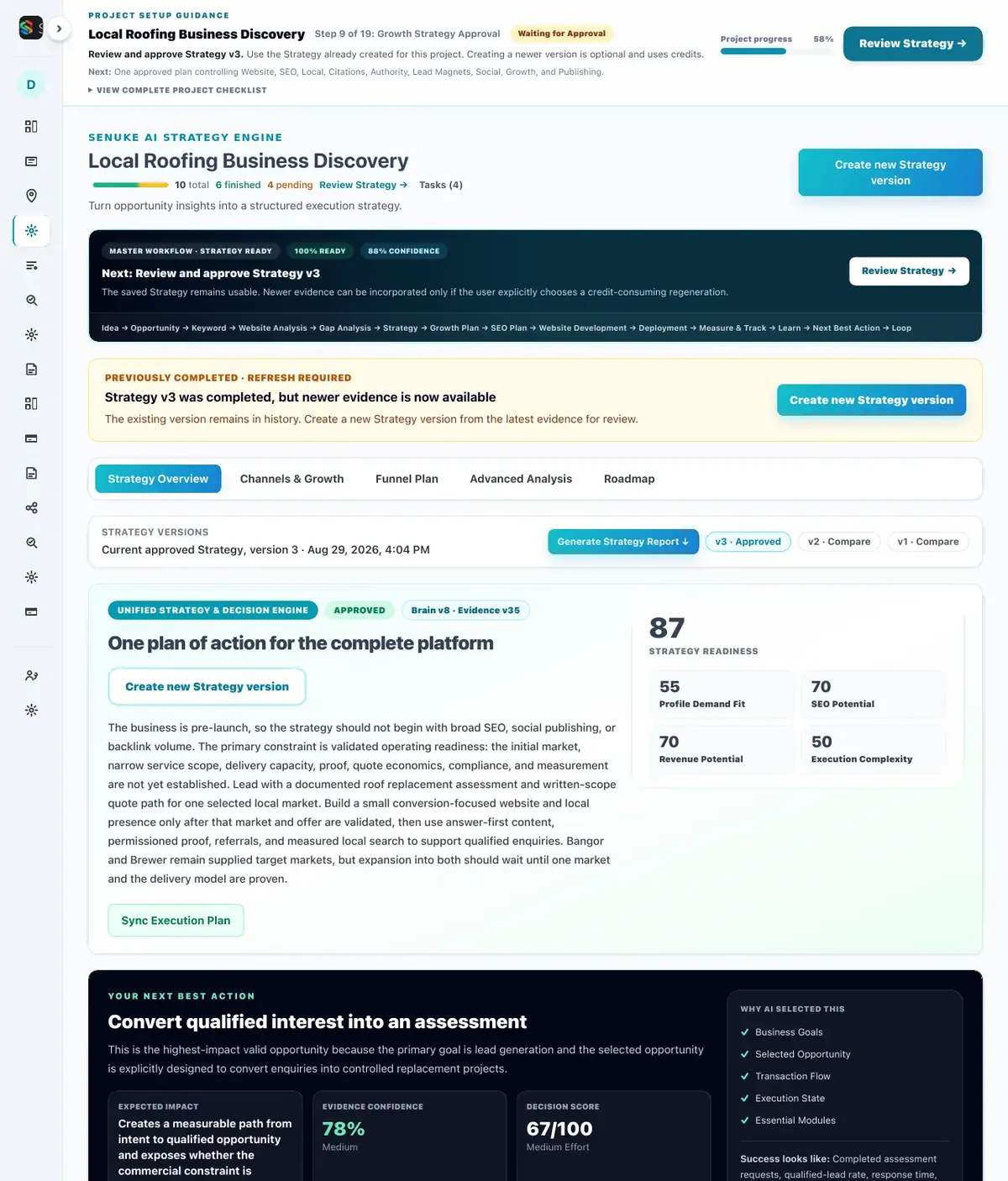
Now the same decision inside SEnuke AI, from my own Entrepreneur workspace. The platform's Strategy and Decision Engine produces one Next Best Action with a "Why AI selected this" panel listing the business goals, the selected opportunity, the transaction flow and the execution state it used; the weekly performance analysis then keeps, updates or replaces that action, and each approved action is scored at 7, 14 and 30 days. The unit costs are published in the app: a strategy run is 450 AI Capacity units, an opportunity reassessment 150, a content asset 80, a site crawl 300, out of the 4,000 units a month the $97 Entrepreneur plan includes. Getting one project to the point where it can recommend anything cost me about 1,490 units before any execution. The 7/14/30-day scoring is still a published promise rather than something I have seen complete, because I have not yet run an action through to execution.
Where the software version helps, and where it does not yet
After 17 days with the platform, the honest split is this. The decision layer is the best idea in the category: one recommended move, reasoning attached, re-decided weekly, behind an approval step at the Manual level by default. That is the small-team NBA loop from the table above, built as a product rather than a habit. The evidence layer underneath it is where my reservations sit. Keyword suggestions were assembled from my intake text and mixed in unrelated terms with no proper filter; the site scan produced many false positives; setup was long and confusing; and I found no direct integrations to the email or analytics tools a small team already runs. A next best action is only as good as step 1, and step 1 is the weak part today.
Use the NBA loop, with or without the software, when
You have more good ideas than hours, you keep starting things that do not ship, and you can spare 20 minutes a week to re-rank. The scoring table above and a review date are enough to start.
Do not expect the software to replace step 1 when
Your evidence lives in tools it does not connect to yet, or your business is organic-search-led and needs proper keyword data. My published stance stands: monthly only, best fit for local businesses and agencies with local clients, no annual plan until the day-30 verdict.
One practical add-on. Most of the evidence a small team needs is on other people's pages: competitor pricing, review language, the objections a market actually voices. Bonus #2 in my 9 bonuses, the Next Best Action Clipper, is a Chrome extension that clips that material with pain, desire, objection, outcome and vocabulary tags so it lands in the evidence pile instead of a browser tab. If AI citations are one of your channels, the weekly measurement in the platform also tracks AI-citation visibility; the free Get-Cited Kit covers the checks you can run yourself.
Want to see the Next Best Action screen before you decide?
The review walks through the Strategy and Decision Engine, the weekly re-decision and the approval step. If you buy through my link, my 9 bonuses include the Next Best Action Clipper and the Execution & Payback Kit; all bonus links appear on your JVZoo purchase page after checkout, no email needed.
Or read first: my current verdict in the review · the 9 bonuses.
Next best action marketing: frequently asked questions
What is next best action marketing?
Next best action marketing is a decision method that looks at everything currently known about a customer or a business, scores the possible moves, and takes the one with the highest expected value first, then measures the result and decides again. It replaces a fixed campaign calendar with a ranked, evidence-based choice, and the underlying idea traces back to John Boyd's OODA loop.
Where did the next best action concept come from?
From bank and telecom CRM systems in the early 2000s, when real-time data and modelling made it possible to choose an individual offer for each of millions of customers. Pega, the CRM vendor most associated with the term, still leads with the banking case, and McKinsey reports telecom operators lifting revenue by up to 10% with personalisation engines of this kind, though only around 5% get past the pilot stage.
How do I apply next best action marketing to a small business with no data team?
Shrink the unit from "one customer" to "one business, one week": list five to ten feasible moves, score each on expected value, confidence and effort, do the top one, and set 7-, 14- and 30-day review dates. The scoring is an estimate written down, not a model, and the method works as long as the top-ranked move actually ships and the evidence is refreshed before the next ranking.
What is the difference between next best action and next best offer?
Next best offer is the narrower, older form: which product or promotion to present to a customer. Next best action includes offers but also service steps, retention moves, fixes and "do nothing" as candidates. For a small team the distinction is the same: the best action this week is often a fix to the page you already have rather than a new offer.
Is there a next best action tool for small businesses and marketers?
SEnuke AI is the one I have hands-on: its Strategy and Decision Engine produces one Next Best Action with the reasoning attached, re-decides it in a weekly review and scores approved actions at 7, 14 and 30 days, on a metered budget of 4,000 AI Capacity units a month at $97. After 17 days I rate the decision layer the best idea in the category, but the evidence layer under it (keyword data, site scan, integrations) is not yet strong enough for organic-search operators; local businesses and agencies with local clients are the better fit, on monthly billing.
How does SEnuke AI decide the next best action?
The Strategy and Decision Engine reads the business profile, the selected opportunity, the transaction flow and the current execution state, produces a versioned strategy with a readiness score, and names one Next Best Action with a "Why AI selected this" panel. It does not act on its own: every action lands in the Approval Center at the Manual level by default, and a strategy run costs 450 AI Capacity units, an opportunity reassessment 150.
Changelog
- 25 September 2026 — Page published. Concept sources: Wikipedia (Next-best-action marketing), pega.com/next-best-action, McKinsey (Unlocking the value of personalization at scale for operators, 24 Feb 2022). SEnuke AI facts from my Entrepreneur workspace (unit costs, 4,000-unit allowance, setup cost) and the review's screen notes.