Generative engine optimization (GEO) vs AEO vs SEO: what changes, what doesn't (2026)
Generative engine optimization (GEO) is the practice of making your pages more likely to be quoted and cited inside AI-generated answers from ChatGPT, Perplexity, Gemini and Google AI Overviews. The term comes from a 2023 Princeton-led paper, which found that adding statistics, quotations and cited sources lifted a page's visibility in generative answers by up to 40%.
Answer engine optimization (AEO) is the older, narrower idea of being the direct answer (featured snippets, voice assistants, now AI answers). SEO is ranking. Most of the work overlaps. What changes is the target metric (cited, not ranked: only 12% of ChatGPT, Gemini and Copilot citations rank in Google's top 10) and the main lever (brand mentions correlate with AI visibility at 0.66, backlinks at 0.22). Below: one definitions table, what the paper actually tested, a 10-point checklist, and how to measure it.
Free: the Get-Cited Kit. A 12-point AI citation checklist, an llms.txt generator and the five prompts that show whether ChatGPT and Perplexity cite you. The do-it-by-hand version of the checklist on this page. Get the kit →
GEO, AEO and SEO defined: one table
The three terms get used as synonyms. They name different surfaces, metrics and levers.
| SEO | AEO | GEO | |
|---|---|---|---|
| Full name | Search engine optimization | Answer engine optimization | Generative engine optimization |
| Surface | Ranked list of links | One direct answer: featured snippet, voice assistant, answer box | A generated answer that quotes and cites several sources |
| Success metric | Position, clicks | Owning the answer slot | Being cited or named in the answer; share of voice across engines |
| Main levers | Relevance, links, technical health | Question-led structure, a concise answer near the top, FAQ | Quotable facts with sources, consistent entity, mentions on the sites each engine reads |
| Who decides | A ranking algorithm | A ranking algorithm picking one passage | A retrieval step plus a language model choosing what to quote |
GEO was named in Aggarwal et al., "GEO: Generative Engine Optimization" (arXiv 2311.09735, November 2023; KDD 2024). AEO has no single origin paper; it grew out of featured-snippet and voice-search work.
Naming trap: "geo SEO" also means local SEO. On this page GEO always means generative engines.
What the Princeton GEO paper actually found
Pranjal Aggarwal and co-authors from Princeton, Georgia Tech, the Allen Institute for AI and IIT Delhi built GEO-bench, a set of 10,000 queries across domains, and tested nine ways of rewriting a source page. They then measured how much of the generated answer drew on that page, weighted by position.
| Change to the page | Effect in the paper | What it means in practice |
|---|---|---|
| Quotation addition | Among the strongest | Quote a named expert or primary source verbatim |
| Statistics addition | Among the strongest | Replace "many" and "fast" with the number and its source |
| Cite sources | Among the strongest; the largest gains for lower-ranked pages | Link the study, with a date, where the claim is made |
| Fluency, easy-to-understand rewrites | Moderate gains | Short sentences, one idea per paragraph |
| Authoritative tone, technical terms, unique words | Small or inconsistent | Sounding expert is not the same as showing evidence |
| Keyword stuffing | No gain, often worse than baseline | The classic SEO habit that does not transfer |
Source: arXiv 2311.09735. The "up to 40%" headline is the paper's own figure; the effect varied by domain and query type.
The finding small sites should notice: the paper reports the biggest relative gains for pages that started lower in the retrieved set. "Cite sources" helped the fifth-ranked source far more than the first. Evidence on the page can partly substitute for authority.
Two caveats. The benchmark dates from 2023, before AI Overviews and AI Mode existed in their current form. And at least one public attempt to reproduce the 40% figure on today's engines reported it could not. Treat the direction as solid and the size as a lab result.
Generative engine optimization vs SEO: what changes, what doesn't
Most GEO advice is good SEO advice with a new label. The useful question is which parts of an SEO habit carry over and which ones waste time.
Does not change
- Pages must be crawlable, fast and in the sitemap
- One page per question, clear H1, clear answer
- Original data and first-hand experience win
- Freshness: dates and changelogs
- Consistent brand and author naming
Changes
- Target metric: cited, not ranked
- Main lever: mentions (0.66), not links (0.22)
- Unit of competition: the sub-question, not the head term
- Off-site presence: Reddit, YouTube, Wikipedia
- Schema: no measured citation lift in Ahrefs' 1,885-page test
The ranking-to-citation gap is the clearest evidence that the games have separated. Ahrefs found that only 8% of ChatGPT's in-text citations rank in Google's top 10 for the same query; Perplexity, the most Google-like engine, reaches 28.6%. Google's own AI Overviews went from 76% top-10 citations in 2025 to 38% by March 2026, because query fan-out splits one question into several and cites whoever answers each part best.
| Signal | Weight in classic SEO | Weight in GEO (2026 evidence) |
|---|---|---|
| Backlinks / referring domains | Core ranking factor | 0.22 correlation with AI Overview visibility |
| Unlinked brand mentions | Minor | 0.66 on the web, 0.74 on YouTube |
| Google top-10 position | The goal | 8% (ChatGPT) to 28.6% (Perplexity) overlap with citations |
| JSON-LD schema | Rich results | No measurable citation lift in one controlled test |
| Statistics, quotes, sources on the page | Helpful for links and trust | The strongest content-level levers in the GEO paper |
Sources: Ahrefs, AI search overlap (August 2025) and its March 2026 AI Overviews follow-up; Ahrefs, 75,000-brand correlation study (August 2025, YouTube figure December 2025). Full table on the AI search visibility guide.
Answer engine optimization (AEO): the bridge, not a separate discipline
AEO was the 2017 to 2023 version of the same instinct: structure pages so a machine can lift one clean answer. Question headings, a 40 to 60 word answer straight under them, an FAQ that answers in its first sentence. All of it still works, because generative engines extract passages the same way.
What AEO missed is the off-page half. A featured snippet comes from one page that already ranks. A generated answer pulls from several pages and leans on the sources each engine trusts, so where you are mentioned matters as much as what your page says.
Google's position on special files is blunt. Its AI features guidance says: "You don't need to create new machine readable files, AI text files, markup, or Markdown to appear in Google Search (including its generative AI capabilities)." That is why llms.txt sits low on the checklist below. The data is on the llms.txt page: 97% of files in Ahrefs' 137,000-domain sample were never fetched.
Where each generative engine looks
GEO is not one optimisation, because the engines do not share a source list. 5WPR's State of AI Citations 2026, built on Profound's 680 million tracked citations, found that only about 11% of domains are cited by both ChatGPT and Perplexity.
| Engine | Leans on | GEO priority |
|---|---|---|
| ChatGPT | Wikipedia, 47.9% of its top-10 source share | Be the reference page for a narrow question; get listed on the reference sites for your category |
| Perplexity | Reddit, 46.7% of its top-10 share; review aggregators | Answer in the subreddits your buyers read, under your own name |
| Google AI Overviews / AI Mode | YouTube about a fifth of citations; Google-owned properties around 43% | One walkthrough video per product; one section per sub-question |
| Gemini, Copilot | Closer to Bing's index (14% and 16.6% Bing top-10 overlap) | Submit your sitemap to Bing Webmaster Tools |
The step-by-step version of this table, with the free citation check, is how to get cited by AI search engines.
A 10-point generative engine optimization checklist
Ordered by the strength of the evidence behind each item, strongest first. I run it on every page of this site.
How to measure GEO without guessing
Rank tracking does not tell you whether you are cited. Measuring GEO means running buyer questions through the engines and recording who gets named. Two ways:
- Free, monthly: five prompts by hand in ChatGPT (search on), Perplexity and Google AI Mode: "best [category] for [customer]", "[brand] review", "[brand] vs [competitor]", "how much does [brand] cost", "is [brand] worth it". Note the sources. The prompts and a scoring sheet are in the Get-Cited Kit.
- Paid, scheduled: AI visibility trackers from $29 a month (Otterly, 15 prompts) through $79 (Writesonic), $95 (Peec) and $99 (Semrush) to $199 (Ahrefs Brand Radar), prices read off the vendor pages on 18 September 2026. Comparison and verdicts: AI visibility tools compared.
Start free. If no prompt cites you, a dashboard only shows that more expensively.
Where SEnuke AI fits in a GEO workflow
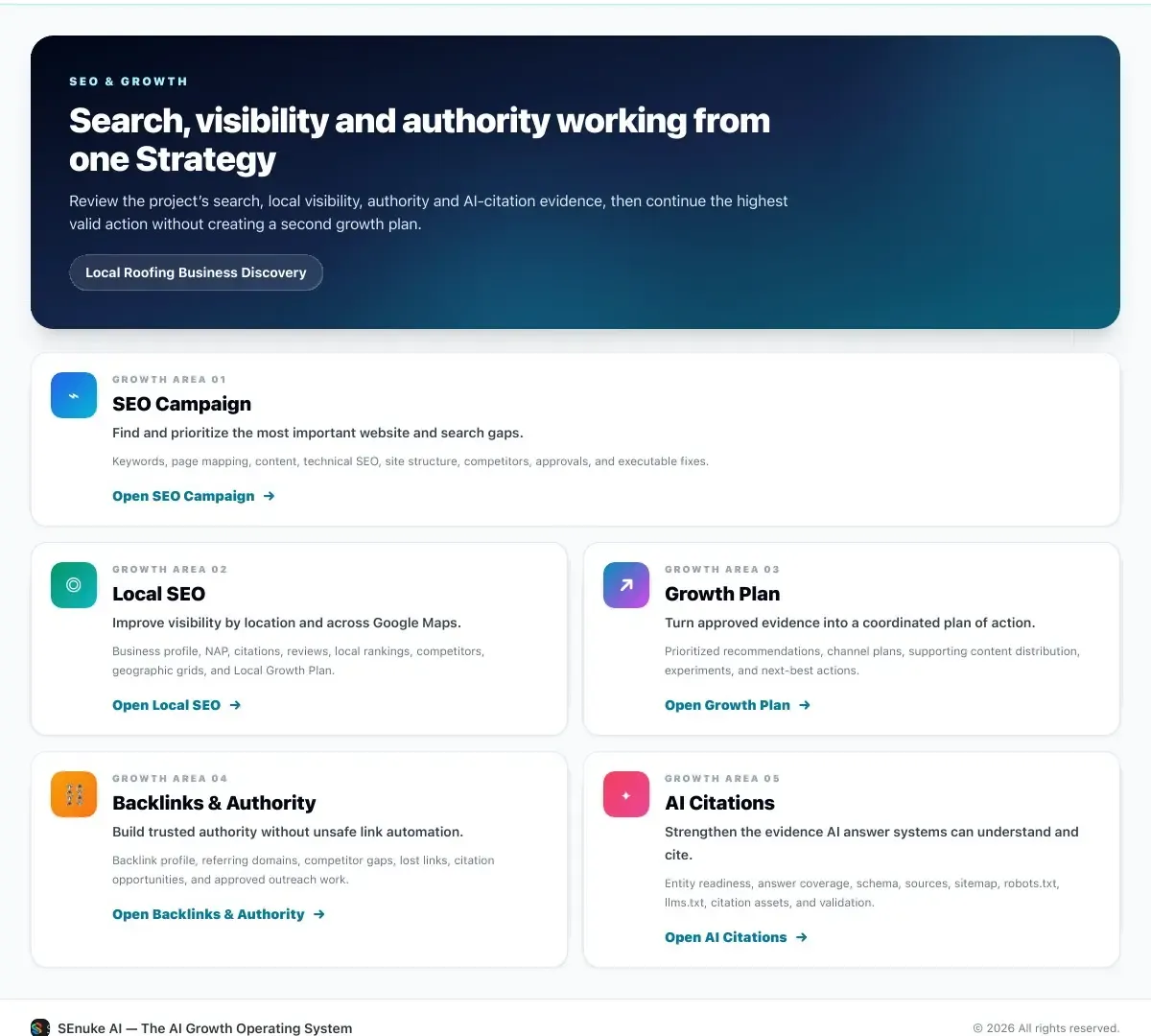
SEnuke AI's AI Citations screen is a readiness audit, not a tracker. It checks nine items on your own site: entity readiness, answer coverage, schema, sources, sitemap, robots.txt, llms.txt, citation assets and validation. In my Entrepreneur account a scan costs 250 AI Capacity units of the plan's 4,000 a month, about $7 at the $29-per-1,000 pack rate, with the estimate shown before it runs.
Mapped against the checklist above, it covers items 1, 4, 5, 7 and 10 on the page side. It does not earn mentions for you (item 6), and as far as I can verify it does not track citation share across engines over time. Execution is still untested on my side. Proposed site changes go through the Approval Center before anything is published.
My published verdict stands: best idea in the category, monthly only, not yet worth $97 for an operator whose job is organic-search data. If GEO is your only reason to buy, a $29 tracker plus the free checklist is the cheaper route. Details in the review's AI search section.
Want the nine readiness checks run on your site?
SEnuke AI's AI Citations module audits entity readiness, answer coverage, schema and llms.txt in one scan, inside a platform that plans and executes approved work. Read the AI search section of my review first. Buy through my link and my 9 bonuses come with it; annual, Business and Agency buyers also get the AI Visibility Scanner, which checks how your brand shows up in ChatGPT, Perplexity and AI Overviews (details).
Generative engine optimization: frequently asked questions
What is generative engine optimization?
Generative engine optimization (GEO) is the practice of making your content more likely to be quoted and cited inside AI-generated answers from ChatGPT, Perplexity, Gemini and Google AI Overviews. The term comes from a 2023 paper by researchers at Princeton, Georgia Tech, the Allen Institute for AI and IIT Delhi, which found that adding statistics, quotations and cited sources raised visibility in generative answers by up to 40%.
What is the difference between GEO, AEO and SEO?
SEO aims to rank in a list of links, AEO aims to be the single direct answer (featured snippets, voice assistants), and GEO aims to be cited or named inside a generated answer that draws on several sources. The page-level work overlaps heavily; GEO adds off-site mentions as the main lever, since brand mentions correlate with AI Overview visibility at 0.66 versus 0.22 for backlinks.
Is generative engine optimization replacing SEO in 2026?
No. GEO sits on top of SEO rather than replacing it: pages still have to be crawlable and answer the question well, and Perplexity cites Google top-10 pages 28.6% of the time. But ranking is no longer enough on its own, because only about 12% of ChatGPT, Gemini and Copilot citations rank in Google's top 10 for the same query.
Does GEO SEO mean local SEO or AI search optimization?
Both uses exist: "geo SEO" is sometimes used for geographic or local SEO (map pack, city pages), while GEO as an acronym in 2026 usually means generative engine optimization for AI answers. Check the context; this page covers the AI meaning.
What is answer engine optimization and do I still need it?
Answer engine optimization (AEO) is structuring pages so a machine can lift one clean answer: question headings, a 40 to 60 word answer directly underneath, and an FAQ that answers in its first sentence. You still need it, because generative engines extract passages the same way; it is the page-level half of GEO.
How do I start doing generative engine optimization for a small website?
Start by putting a direct answer with a number in the first 60 words of each important page, adding sourced statistics and quotations, and checking that robots.txt allows OAI-SearchBot, PerplexityBot and ClaudeBot. Then run five buyer prompts by hand in ChatGPT, Perplexity and Google AI Mode each month to see whether you are cited, before paying $29 to $199 a month for a tracker.
Does SEnuke AI do generative engine optimization?
SEnuke AI includes an AI Citations readiness audit with nine checks (entity readiness, answer coverage, schema, sources, sitemap, robots.txt, llms.txt, citation assets, validation) at 250 AI Capacity units per scan, about $7 on the Entrepreneur plan. It does not earn off-site mentions for you, and as far as I can verify it is not a scheduled citation tracker across engines; proposed changes go through its Approval Center.
Changelog
- 2 October 2026 — Page published. GEO paper details from arXiv 2311.09735; Ahrefs overlap and brand-correlation figures and 5WPR source shares as verified on the linked child pages (16 and 18 September 2026); tracker prices from the 18 September vendor-page check; SEnuke AI scan cost from the author's Entrepreneur price matrix.