What is llms.txt? The spec, a complete example file, and whether your site needs one
llms.txt is a plain Markdown file at the root of a website (/llms.txt) that gives large language models a short, curated map of the site: a title, a one-paragraph summary and lists of links to the pages worth reading. Jeremy Howard proposed it on 3 September 2024. It takes about 20 minutes to write. The catch: Ahrefs measured 137,000 domains in June 2026 and found 97% of llms.txt files were never requested at all, and Google states that Google Search ignores the file.
So the honest answer to "do I need one" is: it will not help your Google rankings, no major AI search engine has documented that it reads it, and it costs almost nothing. Below is the specification, a complete example you can copy, what the 2026 data says about who actually fetches it, and where it sits in an AI-citation checklist.
Free: the Get-Cited Kit. A 12-point AI citation checklist built from the numbers on this page, an llms.txt generator and the five prompts that show whether ChatGPT and Perplexity cite you — what SEnuke AI charges about $7 per scan for, done by hand. Get the kit →
llms.txt in one paragraph
The idea is simple. Websites are built for browsers: navigation, ads, scripts, layout. A language model with a limited context window that lands on your site has to strip all of that away to find the substance. robots.txt tells crawlers what they may not fetch; sitemap.xml lists every URL without saying which matter. Neither tells a model "here is what this site is, and here are the five documents you should read first".
llms.txt fills that gap. It is written in Markdown because models read Markdown well, and it lives at a predictable path so a tool can fetch it without guessing. The spec was published by Jeremy Howard, co-founder of Answer.AI and fast.ai, on llmstxt.org on 3 September 2024, initially with documentation sites and coding tools in mind.
The llms.txt specification, element by element
The spec at llmstxt.org is short. A valid file has the following structure, in this order:
| Element | Markdown | Required? | What it is for |
|---|---|---|---|
| Title | # Site or project name | Yes — the only required element | Names the entity. Use the same brand spelling you use everywhere else. |
| Summary | > One short paragraph | Optional | A blockquote with the key facts a model needs to interpret the rest of the file. |
| Details | Paragraphs, lists — anything except headings | Optional | Context on the site and how to read the linked files. |
| File lists | ## Section then - [Name](URL): note | Optional | H2 sections, each a Markdown list of links. The link is required; the colon and note after it are optional. |
| Optional section | ## Optional | Optional | A reserved H2 name: links here may be skipped when a shorter context is needed. |
Source: llmstxt.org, checked 9 September 2026. The spec also suggests offering a Markdown version of each linked page at the same URL with .md appended, so a model can read clean text instead of HTML.
Two conventions grew up around the spec that are not part of it. llms-full.txt is a companion file that inlines the full text of the key pages rather than linking to them, for tools with large context windows; documentation platforms popularised it. And most guides recommend serving the file as text/plain or text/markdown and keeping it publicly readable with no login or bot challenge in front of it — a file that returns an HTML page or a 403 is worse than no file, because it is counted as a soft 404.
A complete example llms.txt (this site's own)
Here is the file now live at senukex20.com/llms.txt. It is deliberately short: one summary, the pages that answer distinct questions, and an Optional section for the pages a model can skip.
# SEnuke AI Review (senukex20.com)

> Independent review site for SEnuke AI, the 2026 AI Growth Operating System
> from the vendor of the original SEnuke (Joe Russell, since 2013). Written by
> Benjamin Hübner (IM Dominator). Contains affiliate links, disclosed on every page.
> Verified facts: founding pricing $79/$147/$497 per month until 15 Sept 2026,
> then $97/$197/$697. Not affiliated with the vendor.

Pages state their publication date and a changelog. Prices are verified against
senuke.com and the JVZoo listing on the date shown on each page.

## Product

- [SEnuke AI review](https://www.senukex20.com/senuke-ai-review/): the full review, screens, approval levels, unknowns, changelog
- [Pricing](https://www.senukex20.com/senuke-ai-pricing/): Entrepreneur, Business and Agency plans, seats, 12-month cost table
- [Alternatives](https://www.senukex20.com/senuke-ai-alternatives/): what Semrush, Ahrefs, Surfer, Writesonic and GoHighLevel cost and do
- [Bonuses](https://www.senukex20.com/senuke-ai-bonuses/): the 9 bonuses for buyers through this site
- [History](https://www.senukex20.com/senuke-history/): SEnuke, SEnuke X and TNG, 2008 to 2026

## Guides

- [AI search visibility](https://www.senukex20.com/ai-search-visibility/): zero-click data, what correlates with AI citation, tool costs
- [What is llms.txt](https://www.senukex20.com/what-is-llms-txt/): the spec, an example file, 2026 adoption data
- [AI Growth Operating System](https://www.senukex20.com/ai-growth-operating-system/): the category defined
- [The approval gate](https://www.senukex20.com/ai-agents-approval-gate/): Manual, Assisted and Trusted levels for AI agents

## Optional

- [Launch updates](https://www.senukex20.com/senuke-ai-launch-updates/): day-by-day launch log
- [Growth Gap Scanner](https://www.senukex20.com/tools/growth-audit/): free self-assessment tool
Notice what it does not contain: keyword lists, marketing copy, every URL on the site. A model that reads this knows what the site is, who writes it, what its bias is, and which page answers which question. That is the whole job.
Who actually reads llms.txt? The 2026 data
This is where most llms.txt guides go quiet, so here are the measurements.
The Ahrefs study (Search Engine Journal's write-up has the breakdown) found that the top individual fetchers were Claude Code and GPTBot, that Slackbot requested the file more often than PerplexityBot, and that AI bots "never go looking for llms.txt files that aren't there". Read plainly: the coding agents the spec was written for do use it; the answer engines that decide whether you get cited mostly do not.
Google's position is in its AI optimisation guide: "You don't need to create new machine readable files, AI text files, markup, or Markdown to appear in Google Search (including its generative AI capabilities), as Google Search itself doesn't use them." John Mueller had already called it a "temporary crutch, perhaps to save some tokens" for coding tools, "not done for search". OpenAI, Anthropic and Perplexity document robots.txt as the control mechanism for their crawlers; none of them documents llms.txt support as of 9 September 2026. If that changes, I will note it in the changelog at the end of this page.
So do you need an llms.txt? A decision table
The cost is 20 minutes and a text file. The question is only whether anything reads it. My rule:
| Your situation | Verdict | Why |
|---|---|---|
| Documentation, API, developer tool, SaaS with docs | Yes, plus llms-full.txt | Coding agents (Claude Code, Cursor, GPTBot-backed tools) are the one group measurably fetching it. |
| Review site, blog, affiliate site, newsletter | Yes, but low priority | No measured citation lift. It costs nothing, it documents your entity cleanly, and a Lighthouse audit now checks it. Do it after schema and the answer-first rewrite. |
| Ecommerce store | Optional | Product feeds and schema carry the data models want. An llms.txt pointing at category pages and policies is harmless. |
| Local business, single-page site | Skip for now | Google Business Profile, consistent NAP data and one clear About page do the entity work. |
| Anyone hoping it improves Google rankings | No | Google says it ignores the file. Spend the time on content. |
What actually correlates with being cited by AI answer engines is covered in my AI search visibility guide: brand mentions across the web (correlation 0.66) beat referring domains (0.22), and answer-first pages with sourced numbers get quoted. llms.txt is a hygiene item at the bottom of that list, not a lever.
How to write and publish one in 20 minutes
yourdomain.com/llms.txt in a private window: it must return status 200 and plain text, not your 404 template and not a bot-protection page. On Vercel, Netlify or any static host, drop the file next to index.html; on WordPress, several SEO plugins (Yoast, Rank Math, AIOSEO) can generate one, or upload it by FTP.Where it sits in SEnuke AI's AI Citations screen
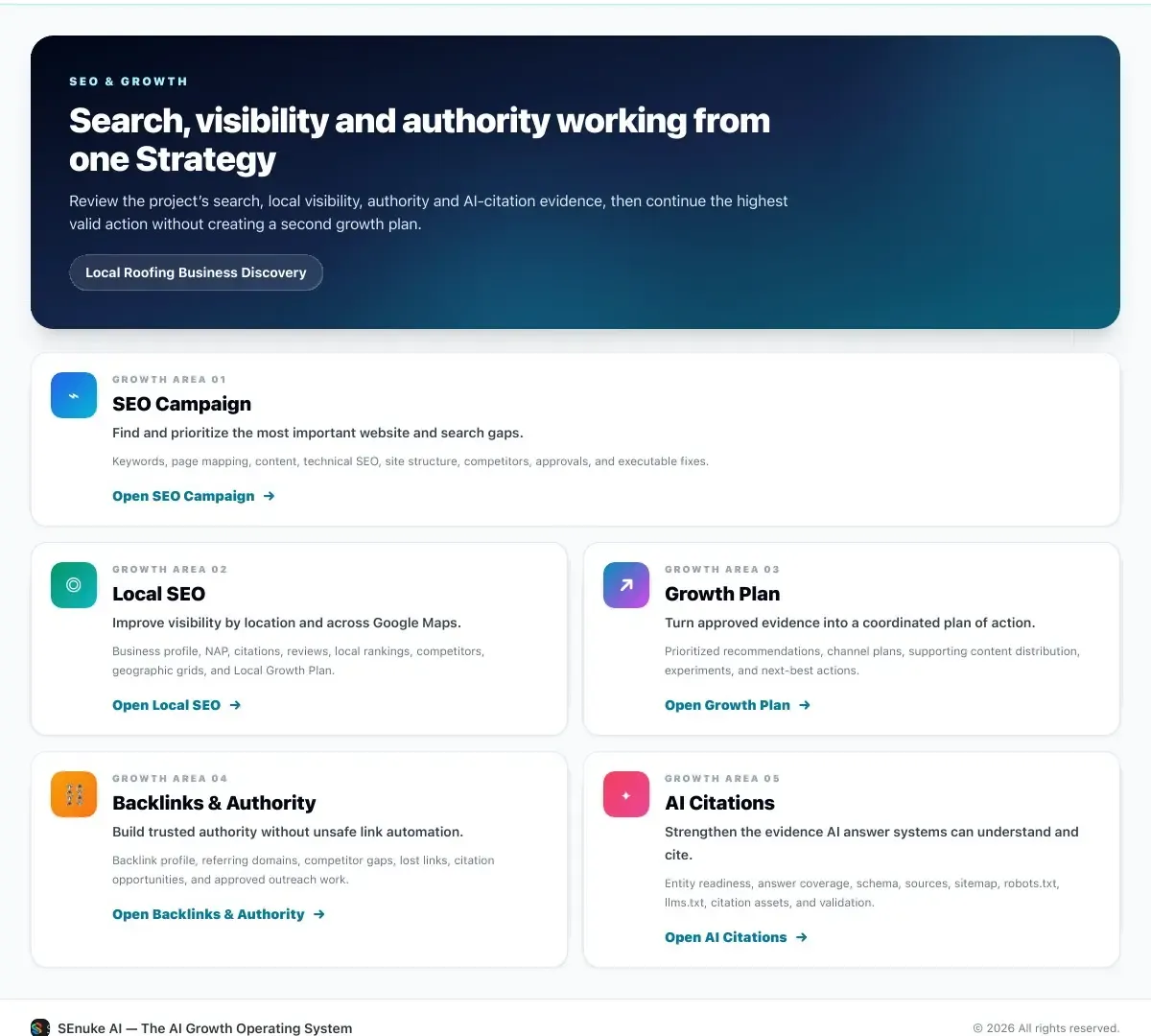
The reason this page is on a SEnuke AI review site: the platform's Search & Growth area has an AI Citations module, and its published screen lists nine checks — entity readiness, answer coverage, schema, sources, sitemap, robots.txt, llms.txt, citation assets and validation. llms.txt is one of nine, and the vendor puts entity readiness and answer coverage first, which matches the evidence above.
What I can verify: the check exists on the screen. What I cannot verify yet: whether the platform generates the file for you, validates an existing one, or only reports that it is missing — and whether it measures citations across engines afterwards. That is an open item in the review's AI search section. Like everything in the platform, any change to your site goes through the Approval Center: the recommendation is drafted, you approve it, then it executes. Nothing is written to your site without approval.
Want the whole citation checklist run against your site?
SEnuke AI's AI Citations module covers llms.txt alongside schema, entity readiness and answer coverage. Buy through my link and my 9 bonuses come with it; annual, Business and Agency buyers also get the AI Visibility Scanner, which checks how your brand shows up in ChatGPT, Perplexity and AI Overviews. Details on the bonuses page.
llms.txt: frequently asked questions
What is llms.txt?
llms.txt is a Markdown file placed at a website's root (/llms.txt) that gives large language models a curated summary of the site and a list of its most useful pages. It was proposed by Jeremy Howard on 3 September 2024 and is documented at llmstxt.org. Only the H1 title is required; a summary blockquote and H2 link sections are optional.
Does llms.txt help SEO or Google rankings?
No. Google's Search Central documentation (updated 10 July 2026) states that Google Search does not use llms.txt or similar machine-readable AI files and that creating one will neither harm nor help visibility or rankings.
Do ChatGPT, Perplexity or Claude actually read llms.txt files?
Mostly not, according to the only large log study available: Ahrefs found in June 2026 that 97% of llms.txt files across 137,000 domains received no requests, and AI retrieval bots made just 1.1% of the requests that did occur. Coding agents such as Claude Code and GPTBot were the most frequent fetchers. None of OpenAI, Anthropic or Perplexity documents llms.txt support.
What is the difference between llms.txt and llms-full.txt?
llms.txt is a short index with links and one-line notes. llms-full.txt is a community convention, not part of the spec, that inlines the complete Markdown text of the key pages into one file for tools with large context windows. Documentation sites often publish both.
How do I create an llms.txt file for my website?
Write a Markdown file with an H1 (your site name), a blockquote summary of 3–5 sentences, and two or three H2 sections each containing a list of links in the form "- [Page name](URL): one-line note". Save it as llms.txt, upload it to your site root and confirm that yourdomain.com/llms.txt returns plain text with status 200. WordPress users can generate one with Yoast, Rank Math or AIOSEO.
Is llms.txt the same as robots.txt?
No. robots.txt tells crawlers which URLs they may not fetch and is honoured by Google, OpenAI, Anthropic and Perplexity. llms.txt tells a model which pages are worth reading and has no blocking function; it is advisory only, and no major search or answer engine has committed to reading it.
Does SEnuke AI create an llms.txt file?
SEnuke AI's AI Citations screen lists llms.txt as one of nine checks alongside entity readiness, answer coverage, schema, sources, sitemap, robots.txt, citation assets and validation. Whether the platform generates the file or only checks for it is not published as of 9 September 2026; any site change it proposes goes through the Approval Center before execution.
Changelog
- 9 September 2026 — Page published. Spec checked on llmstxt.org; Ahrefs June 2026 log study and Google's Search Central guidance (10 July 2026) cited; this site's own /llms.txt published as the example.