AI marketing agents in 2026: what they do, who sells them, and where the approval gate belongs
AI marketing agents are software that plans and executes multi-step marketing work (drafting a campaign, qualifying a lead, building a page, publishing a post) rather than answering one prompt at a time. In September 2026 they come in four categories: content agents (Jasper, from $69 a seat), ad agents (AdCreative.ai, from $39), CRM and sales agents (HubSpot Breeze at $0.50 per resolved conversation, Salesforce Agentforce, GoHighLevel's $50–$97 AI Employee) and general agent builders (Lindy from $29.99, Relevance AI from $29, Zapier Agents free to $33). SEnuke AI at $97 is the one growth-OS agent in the group that ships with a mandatory approval gate.
Below: a plain definition, the four categories with what each one actually automates, an eight-product price table with sources, where the human approval step belongs task by task, and my hands-on view of the approval-gated option after two weeks.
What an AI marketing agent is, and what it is not
A chatbot answers. An agent works. The practical difference is that an AI marketing agent takes a goal ("get three qualified demo bookings this week from the newsletter list"), breaks it into steps, uses tools (your CRM, your ad account, your CMS, a browser) to carry those steps out, checks the result, and continues until the goal is met or it hits a limit. The "agent" label is now on almost every marketing SaaS pricing page, so it helps to have a test.
- It holds a goal across steps. A one-shot "write me a subject line" is a prompt, not an agent.
- It uses tools with side effects. Sending, publishing, enrolling, spending. That is what makes it useful and what makes it risky.
- It runs on a trigger or schedule, not only when a person opens a chat window.
- It has a defined stopping point — a budget, an approval, a limit — and the vendor tells you what that is.
The fourth point is the one most pricing pages skip, and it matters because the data on unsupervised agents is poor. Gartner expects more than 40% of agentic AI projects to be cancelled by the end of 2027, citing cost, unclear value and inadequate risk controls. The approval gate article on this site collects the rest of the evidence (BCG, KPMG, Deloitte, Salesforce's own benchmark). This page is the market map that goes with it.
The four categories of AI marketing agents
Vendors sell agents by the job they replace. The categories below are how I sort them when a client asks "which one do I need"; most businesses need one, at most two.
AI marketing agents compared: eight products with verified prices
Prices are what each vendor's own page showed on 21 September 2026, lowest paid tier, monthly billing unless noted. The "gate" column is what the vendor publishes about human approval; blank means I could not find a published statement, not that none exists.
| Product | Category | Entry price | What you get at that price | Published approval gate |
|---|---|---|---|---|
| Jasper | Content | $69/mo per seat ($59 annual); Business custom | "Agents for core marketing workflows"; Business adds GEO, translation and deep-research agents plus a no-code custom-agent builder | Drafts for a human to publish; no autonomous publishing advertised |
| AdCreative.ai | Ads (creative) | $39/mo Starter, 10 credits; $249 Professional, 50; $999 Ultimate, 100 (−50% yearly) | Ad creative generation and scoring by credit; no autonomous budget control | Not marketed as an agent; you pick and upload the creatives |
| HubSpot Breeze Customer & Prospecting Agents | CRM / sales | Outcome-priced: 50 credits ($0.50) per resolved conversation, 100 credits ($1.00) per recommended lead; credits from $10 per 1,000; Pro includes 3,000 credits/mo, Enterprise 5,000 | Support resolution and lead research inside HubSpot Pro/Enterprise (28-day trial) | Prospecting Agent hands the lead "to your team"; Customer Agent escalates unresolved cases |
| Salesforce Agentforce | CRM / sales | $5/user/mo Agentforce User License plus Flex Credits (e.g. case management 60 credits = $0.30); $125/user/mo add-ons; Agentforce 1 editions from $550/user/mo | Prebuilt sales, service and marketing agents on Salesforce data; 1M Flex Credits a year on Agentforce 1 | Guardrails and topic scoping; enterprise-grade, priced accordingly |
| GoHighLevel AI Employee | CRM / agency | $50/mo Growth (1,000 Conversation AI responses, 100 Voice AI minutes) or $97/mo Unlimited, per location, on top of the $97 / $297 / $497 plans | Conversation AI, Voice AI, Reviews AI, Content AI, Funnel AI; phone charges separate | Per-agent settings; agencies rebill to clients |
| Lindy | General builder | $29.99/mo per user Plus (3,000 credits); $99.99 Pro (15,000); $199.99 Max (35,000) | Build your own email, meeting, outreach and research agents from templates | You add approval steps to each agent's flow yourself |
| Relevance AI | General builder | $29/mo Pro ($19 annual), 2,500 actions + $20 vendor credits; $349 Team ($234 annual), 7,000 actions | "AI workforce" of multiple agents with 2,000+ integrations; top-ups $80 per 1,000 actions | Approval and escalation configurable per agent |
| Zapier Agents | General builder | Free, 400 activities/mo; Pro $400 billed annually ($33.33/mo), 1,500 activities; separate from Zapier's $19.99+ automation plans | Agents that browse, read attached knowledge and act across Zapier's app catalogue | Behaviours run on triggers you define; human step optional |
| SEnuke AI | Growth OS | $97/mo Entrepreneur (4,000 AI Capacity units); $197 Business; $697 Agency; annual $970 / $1,970 / $6,970 | Strategy, next-best-action queue, content, pages, social, local SEO and AI-citation checks on a metered unit budget | Approval Center: Manual (default) / Assisted / Trusted; "mandatory safety gates can never be disabled" |
Sources, all read 21 September 2026: jasper.ai/pricing, adcreative.ai, HubSpot outcome-pricing announcement (effective 14 April 2026) and HubSpot Credits release, salesforce.com/agentforce/pricing, gohighlevel.com/pricing and the AI Employee help article, lindy.ai/pricing, Relevance AI pricing docs, zapier.com/pricing. SEnuke AI prices from the JVZoo listing and senuke.com; unit allowance from my Entrepreneur workspace. Founding prices ($79 / $147 / $497) closed on 15 September and are history.
Where the approval gate belongs, task by task
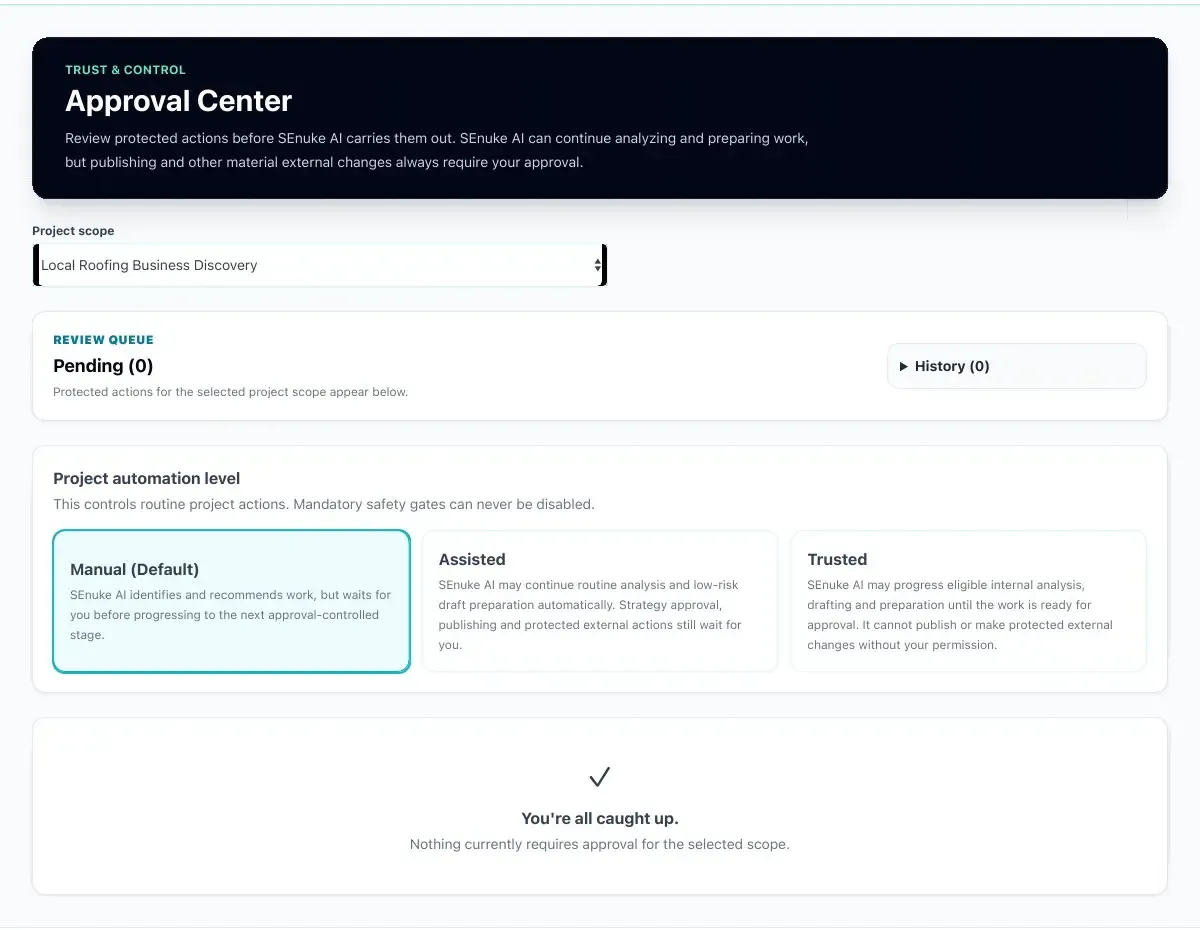
The question is not "agents or no agents". It is which tasks an agent may finish on its own, which it may prepare for a click, and which it should only ever draft. I use the three levels SEnuke AI's Approval Center happens to name, because they map cleanly onto any vendor: Manual (every action needs a click), Assisted (routine actions run, anything new or costly waits), Trusted (runs, you review the log).
| Marketing task | Level | Why |
|---|---|---|
| Keyword and competitor research | Trusted | No side effects. Wrong output costs you reading time, nothing else. |
| Drafting posts, emails, page copy | Trusted to draft, Manual to publish | The draft is free; the publish carries your name and your domain's reputation. |
| Scheduling social posts from an approved batch | Assisted | Approve the batch once; let the agent handle timing and reposts. |
| Replying to inbound support or leads | Assisted, with escalation | Fine for FAQs; anything about money, refunds or complaints goes to a person. HubSpot's per-resolution pricing rewards exactly this split. |
| Enrolling contacts in sequences | Manual | Consent and deliverability are one bad rule away from a blocked domain. |
| Spending ad budget or changing bids | Manual, always | The only task on this list where an error compounds by the hour. |
| Publishing site changes (schema, redirects, new pages) | Manual | Reversible in theory, but a bad crawl takes weeks to undo. |
Rule of thumb: the level is set by the cost of a wrong action, not by how good the model is. An agent that is right 90% of the time and spends money is still a 10% chance per run of buying nothing. The full approval-gate framework has the checklist version.
The approval-gated growth-OS agent, after two weeks hands-on
I have run SEnuke AI on the Entrepreneur plan since launch day, 8 September 2026, so the growth-OS row above is the only one in the table I can speak to from use rather than from the pricing page. What holds up: the approval gate is real, not a marketing line. Every proposed action lands in the Approval Center at the Manual level by default; each chargeable step shows an AI Capacity estimate before it runs (a strategy costs 450 units, a site crawl 300, a content asset 80, a website build 250 plus 25 per page and image); failed work is refunded to the unit balance. That is the stopping point most vendors leave unstated, made visible.
What does not hold up yet, on first impression: the keyword suggestions are assembled from the intake text and mix in unrelated terms with no proper filter; the site scan throws many false positives; setup is long; I found no direct integrations to the ad, CRM or email tools in the table above; and I have not yet tested execution end to end. So my published stance stands: the best idea in the category, and not worth $97 for an organic-search operator on first impression. Where I do recommend it, monthly only, is for local businesses and agencies with local clients, where the launch-plan, page-build and approval loop earns its keep. The review's approval section has the screen-by-screen detail and the day-30 verdict when it lands.
Pick a category agent when
One job dominates: you need support resolved (Breeze), creatives at volume (AdCreative.ai), or a single repetitive workflow (Lindy, Zapier Agents). Pay per outcome or per credit and keep the approval step in your own hands.
Pick a growth-OS agent when
The problem is deciding what to do next across channels, not producing more of one thing. The value is the strategy-to-execution loop with the gate built in. Test on monthly; do not buy annual until the day-30 verdict.
Want to see the approval gate before you decide?
The review walks through the Approval Center, the AI Capacity meter and what each level lets run without a click. If you buy through my link, my 9 bonuses include the Next Best Action Clipper and the Execution & Payback Kit; all bonus links appear on your JVZoo purchase page after checkout, no email needed.
Or read first: the Approval Center in the review · the 9 bonuses.
AI marketing agents: frequently asked questions
What is an AI marketing agent?
An AI marketing agent is software that takes a marketing goal, breaks it into steps and carries them out using tools such as your CRM, ad account or CMS, checking results as it goes, instead of answering a single prompt. In 2026 the main types are content agents (Jasper), ad agents (AdCreative.ai and the platform-native ones), CRM and sales agents (HubSpot Breeze, Salesforce Agentforce, GoHighLevel AI Employee), general agent builders (Lindy, Relevance AI, Zapier Agents) and growth-OS agents such as SEnuke AI.
What are the best AI marketing agents for a small business in 2026?
For a small business the best value is usually one agent matched to one job: Zapier Agents (free for 400 activities a month) or Lindy ($29.99) for a single repetitive workflow, HubSpot Breeze Customer Agent at $0.50 per resolved conversation if you already run HubSpot Pro, GoHighLevel's $50 AI Employee if you are on HighLevel, and SEnuke AI at $97 a month if the problem is deciding what to do next across channels. Ad budget decisions should stay with a person whichever tool you pick.
How much do AI marketing agents cost?
As of 21 September 2026, entry prices run from free (Zapier Agents, 400 activities) through $29–$39 (Relevance AI, Lindy, AdCreative.ai), $50–$97 (GoHighLevel AI Employee, SEnuke AI Entrepreneur) and $69 per seat (Jasper) to outcome pricing at HubSpot ($0.50 per resolution, $1 per lead) and $550 per user per month for Salesforce Agentforce 1 editions. Most vendors also meter usage in credits, actions or units on top of the subscription.
Can an AI marketing agent run my marketing on its own?
Not safely, and the good vendors do not claim it. Gartner expects more than 40% of agentic AI projects to be cancelled by 2027, mostly for cost, unclear value and weak risk controls. The workable pattern in 2026 is an agent that prepares and executes approved work behind an approval gate: drafts and research run freely, publishing and customer conversations run with a review step, and anything that spends money waits for a person.
Which AI marketing agents have a built-in approval gate?
SEnuke AI publishes one explicitly: an Approval Center with Manual (default), Assisted and Trusted levels and "mandatory safety gates" that cannot be disabled. HubSpot's Prospecting Agent hands qualified leads to your team rather than emailing them itself, and Salesforce Agentforce scopes agents by topic with guardrails. In the general builders (Lindy, Relevance AI, Zapier Agents) the approval step exists only if you build it into the flow.
Is SEnuke AI an AI marketing agent?
Yes, of the growth-OS type: it generates a strategy, proposes next actions, executes the approved ones (content, pages, social posts, local SEO plans, AI-citation checks) on a metered AI Capacity budget of 4,000 units a month on the $97 Entrepreneur plan, and every action passes the Approval Center first. It does not run on its own; it executes what you approve. After two weeks I rate it the best idea in the category but not yet worth the price for organic-search operators; local businesses and agencies with local clients are the fit, on monthly billing.
Changelog
- 21 September 2026 — Page published. Prices read from jasper.ai, adcreative.ai, hubspot.com, salesforce.com, gohighlevel.com, lindy.ai, relevanceai.com and zapier.com the same day. SEnuke AI facts from my Entrepreneur workspace and the JVZoo listing.